An unfamiliar software error can interrupt your work, prevent an application from opening, or make you worry about your device’s safety. The reedoor2.4.6.8 data error is one such search term, but its exact technical meaning has not been confirmed by an identifiable software developer. Guessing at the cause or installing an unknown repair tool could create further problems. This guide explains how to investigate the message, check common data-related issues, and choose safe troubleshooting steps without risking important files.
What Is the Reedoor2.4.6.8 Data Error?
The reedoor2.4.6.8 data error is a phrase people may encounter while researching an unfamiliar error message, application, or file. However, without an official product page, developer documentation, or the original error message, it is not possible to identify a confirmed error code or assign it to a specific program.
The number sequence resembles a software version number, but that alone does not prove that it identifies a legitimate application or a particular software release.
To understand the issue, first determine where the name appeared:
- Application window: A program may be reporting a problem with its own data or configuration.
- Browser pop-up: A website may be displaying a warning that needs independent verification.
- Windows notification: The message may originate from Windows, an installed application, or a security product.
- Downloaded file: An unfamiliar filename requires a careful safety check before you open it.
- Technical log: The complete log entry may identify the application or component responsible.
The source of the message matters more than the unusual name itself.
What Causes a Data Error?
A data error can have several causes, depending on the application and the operation that failed. The following possibilities are common in software troubleshooting, but none has been confirmed as the specific cause of the reedoor2.4.6.8 data error.
1. Corrupted Application Data
An application may fail to read its settings, temporary files, or saved information after an unexpected shutdown. Damaged local data can also prevent an application from loading correctly.
2. Insufficient Storage Space
When a device runs low on available storage, applications may struggle to save downloads, update files, or complete tasks that require temporary space.
3. Network Connection Problems
An application that depends on an online service may fail to retrieve information when the internet connection drops or the remote server becomes unavailable.
4. Outdated Software
Older software may contain bugs or compatibility problems that affect certain operations. Installing updates from the verified developer may resolve a genuine application issue.
5. Incorrect Configuration
A changed setting, invalid file path, or missing permission can stop a program from accessing the information it needs.
6. Suspicious Software or Misleading Alerts
If the message asks you to install an unknown cleaner, download an unverified repair file, or call an unfamiliar support number, treat it cautiously. A warning alone does not establish that your device contains malware.
How to Fix the Reedoor2.4.6.8 Data Error Safely
The safest approach is to identify the source before making changes. Follow these steps in order and stop if you discover that the message comes from an unverified download or suspicious website.
Step 1: Record the Complete Error Message
Take a screenshot or write down the full text. Include the application name, any error number, the time the message appeared, and the action you were performing.
This information can help distinguish a genuine application failure from a misleading browser notification.
Step 2: Restart the Application
Close the affected application and open it again. If it remains unresponsive, restart the device after saving any work you can safely preserve.
A restart can resolve temporary software problems, although it will not repair every underlying data issue.
Step 3: Check Your Internet Connection
If the error appears while downloading, syncing, or accessing an online service, check your connection.
Try opening a trusted website and, if appropriate, switching between Wi-Fi and mobile data. If the service itself is unavailable, wait and try again rather than installing an unofficial fix.
Step 4: Check Available Storage
Make sure your device has enough free space for the affected application to operate.
On Android, open Settings → Storage. On Windows, open Settings → System → Storage. The precise menu names can vary by device and operating system version.
Remove only files you no longer need, and back up important information before deleting anything.
Step 5: Update the Affected Application
Check for updates through the application’s official website, the Microsoft Store, Google Play, or the appropriate verified distribution channel.
Avoid third-party download pages that promise a special Reedoor repair utility without identifying a trustworthy developer.
Step 6: Clear the Application Cache if Appropriate
On Android, temporary cached files can sometimes cause performance or loading issues.
- Open Settings.
- Select Apps or Applications.
- Choose the affected application.
- Open Storage or Storage and cache.
- Select Clear cache, if available.
Google explains the difference between clearing cache and clearing app storage in its official Android storage guidance.
Important: Do not select Clear storage or Clear data unless you understand the consequences. These actions can remove local settings, saved sessions, or other application data.
Step 7: Run a Security Scan if the Message Looks Suspicious
If you find an unknown executable, an unexpected installation, or a warning that urges you to download a repair program, use a trusted security tool.
For Windows:
- Open Windows Security.
- Select Virus & threat protection.
- Open the available scan options.
- Run a full scan if you suspect unwanted software.
- Review Protection history for any actual detections.
Use Microsoft’s official Windows Security documentation for further guidance.
Step 8: Reinstall Only the Identified Application
If the problem continues, consider reinstalling the application that actually generated the message. First, back up important files and confirm that you can recover any account information or locally stored data.
Download the replacement only from a verified source. Do not uninstall system components or delete unfamiliar files simply because their names resemble the error phrase.
Step 9: Contact the Verified Developer
If the error remains, send the developer the exact message, application version, operating system, and steps that reproduce the problem.
A verified support team can determine whether the issue relates to application data, compatibility, a service outage, or another cause.
Reedoor2.4.6.8 Data Error Troubleshooting Table
Use this table to match the situation you observe with a reasonable first step. These are general diagnostic recommendations, not confirmed Reedoor-specific fixes.
| Symptom | Possible explanation | Recommended action | Risk level |
| Application will not open | Temporary failure or damaged settings | Restart and check for updates | Low |
| Error appears during a download | Network interruption or unavailable server | Check the connection and retry | Low |
| Device reports low storage | Insufficient free space | Review storage and remove unnecessary files | Low |
| Error appears after an update | Compatibility or configuration problem | Check official support guidance | Low to moderate |
| Application repeatedly crashes | Software bug or corrupted local data | Back up data and troubleshoot the identified app | Moderate |
| Unknown security warning appears | Browser notification, misleading alert, or genuine security event | Verify the source and run a trusted scan if warranted | Depends on evidence |
| Unknown executable appears | Unidentified downloaded or installed software | Do not run it; inspect its source and scan it | Potentially high |
| A repair website requests payment or remote access | Possible deceptive support offer | Do not pay or grant access until independently verified | Potentially high |
How to Check Whether Reedoor2.4.6.8 Is Legitimate
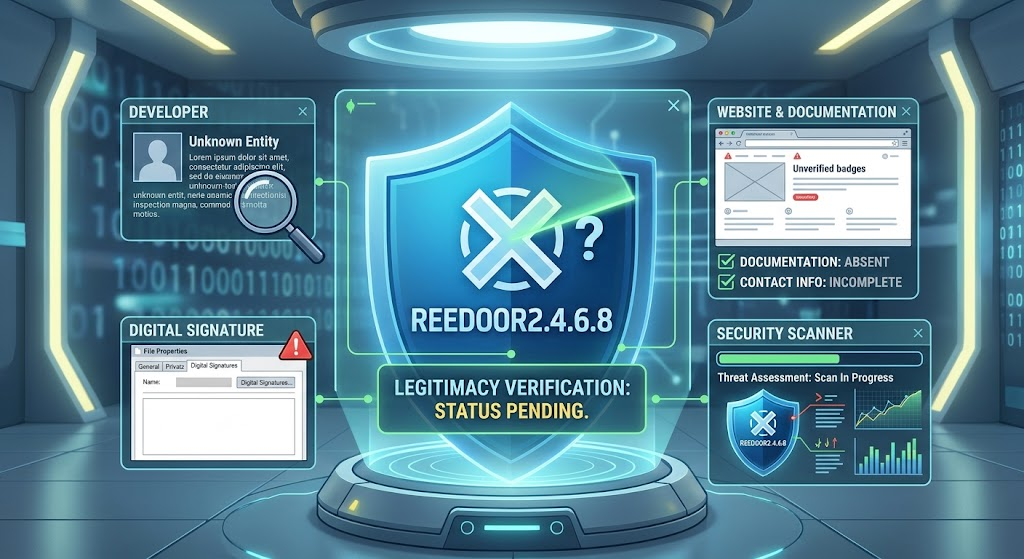
Before trusting a program associated with the name, verify its identity. A professional-looking website or version number does not establish that software is authentic.
Check the following details:
- Official developer: Can you identify the company or individual responsible for the software?
- Official website: Does the developer provide documentation, contact information, and a genuine download page?
- Publisher information: Does the installed program identify a publisher that you can independently verify?
- Digital signature: On Windows, check the file’s Properties for a Digital Signatures tab, when available. An absent signature is not conclusive proof of malware, and a signature alone does not guarantee safety.
- Independent security results: If a file is suspicious, a reputable security scanner can help assess it. Do not upload confidential files to public scanning services without considering their privacy policies.
- Consistent documentation: Does the developer explain what the software does, which versions it supports, and how to resolve known errors?
No specific Reedoor developer or official technical documentation has been established for this article. Therefore, the name should remain unverified until reliable evidence identifies its source.
Is the Reedoor2.4.6.8 Data Error a Virus?
The phrase alone does not prove that a device is infected. An ordinary software failure, an unknown filename, and a genuine malware detection are different situations that require different responses.
Look at the evidence surrounding the message.
If a browser displays a warning that says your computer is infected and urges you to download a tool immediately, close the page without clicking its download button. If your existing security software reports a detection, open that security product directly and inspect its detection details.
For Windows users, Microsoft Defender can provide relevant scan results through Windows Security. Follow the actions recommended for the actual detection rather than relying on a search result to identify an unknown file.
If you already ran a suspicious program, disconnect the device from the internet if you suspect active malicious activity, run a trusted security scan, and use a separate trusted device to secure important accounts if necessary.
How to Protect Your Files During Troubleshooting
Fixing a software problem should not create a second problem by deleting important information.
Follow these precautions before attempting advanced repairs:
- Back up important files. Keep a copy of essential documents and photographs in a trusted backup location.
- Avoid unknown repair tools. Never run an executable just because a website claims it will fix the error.
- Protect account credentials. Do not enter passwords or payment information into unexpected pop-ups.
- Avoid unnecessary registry changes. Editing Windows registry entries without knowing their purpose can cause further system problems.
- Preserve error logs. Screenshots and logs may help a developer identify the actual cause.
- Use official updates. Obtain application and operating system updates through verified channels.
- Check backups before resetting anything. A factory reset or clean installation can erase personal data.
These precautions help you investigate the reedoor2.4.6.8 data error without assuming that the name itself reveals the cause.
Reedoor2.4.6.8 Data Error on Windows vs. Android
The correct troubleshooting method depends on where the message appears. Windows and Android use different application management and security tools.
| Diagnostic task | Windows PC | Android device |
| Check the source | Identify the application or notification | Identify the app or browser showing the message |
| Check storage | Settings → System → Storage | Settings → Storage |
| Update software | Microsoft Store or verified developer | Google Play or verified developer |
| Clear temporary data | Use the application’s supported settings | Settings → Apps → affected app → Storage |
| Check security | Windows Security or a trusted security product | Google Play Protect and trusted device security tools |
| Remove unwanted software | Settings → Apps → Installed apps | Settings → Apps → select the identified app |
| Find further help | Verified software developer or Microsoft Support | App developer or device manufacturer’s support |
Menu names may differ between operating system versions and device manufacturers. Do not follow a procedure designed for one platform if the error appears on another.
What to Do If the Error Returns
If the message disappears and then returns, keep a short record of the events surrounding it. Repeated failures can provide more useful clues than the name alone.
Record:
- The date and time of each occurrence.
- The application that was open.
- Whether the device was online.
- Any recent software installation or update.
- The complete error text.
- Any action that makes the error appear or disappear.
Next, reproduce the issue only if doing so is safe. If the error occurs whenever you open one application, focus on that application’s settings and support resources. If it appears across multiple programs, investigate wider system, storage, or security issues.
Do not repeatedly install repair tools or delete files in an attempt to make the message disappear. Each change can make it harder to identify the original cause.
Official Resources for Reliable Troubleshooting
Use primary sources that explain the operating system or security product involved. These resources provide documented procedures for common issues, although none should be interpreted as confirmation of a Reedoor-specific error code.
- Google Android Help: Free up storage on your Android device explains app storage, cache, and data management.
- Google Play Help: Keep your device and apps working with Google Play services covers Google Play services troubleshooting.
- Microsoft Support: Windows support provides official Windows troubleshooting and security guidance.
- Microsoft Security: Microsoft Defender Antivirus documents Microsoft’s built-in antivirus protection.
- Android: Official Android website provides information about Android devices, software, and security.
For the most accurate solution, start with the source of the message and select the official guidance that matches your device and application.
Frequently Asked Questions
It is an unverified error phrase without a confirmed technical definition in the information available for this guide. Identify the application and capture the complete message before attempting a fix.
Start by restarting the affected application, checking your internet connection and storage, and installing verified updates. Clear cache only when appropriate, and back up important data before advanced troubleshooting.
The name alone does not establish that it is malware. Verify the source, inspect any actual security detection, and avoid running unknown files or downloading unverified repair tools.
Do not delete files based on their names alone. First identify their location, publisher, and relationship to an installed application; scan suspicious files with a trusted security tool.
Repeated messages may result from an unresolved application problem, configuration issue, storage limitation, or another cause. Keep a record of when the message appears and use the details to narrow down the source.
No verified official repair tool has been established for this error phrase. Avoid download links that cannot be traced to a legitimate developer, and use the support resources for the application that generated the message.
Conclusion
The reedoor2.4.6.8 data error requires careful investigation rather than guesswork. Its exact origin and technical meaning remain unverified, so the best starting point is to identify the application, preserve the full error message, and check common causes such as storage limitations, temporary failures, and outdated software.
Use official troubleshooting instructions, protect important files, and avoid unknown repair downloads. If the message continues, contact the verified developer with the information you collected.
Have you encountered this message on Windows, Android, or inside a browser? Sharing the exact error text and the application that displayed it can help narrow down the cause and identify the next appropriate troubleshooting step.