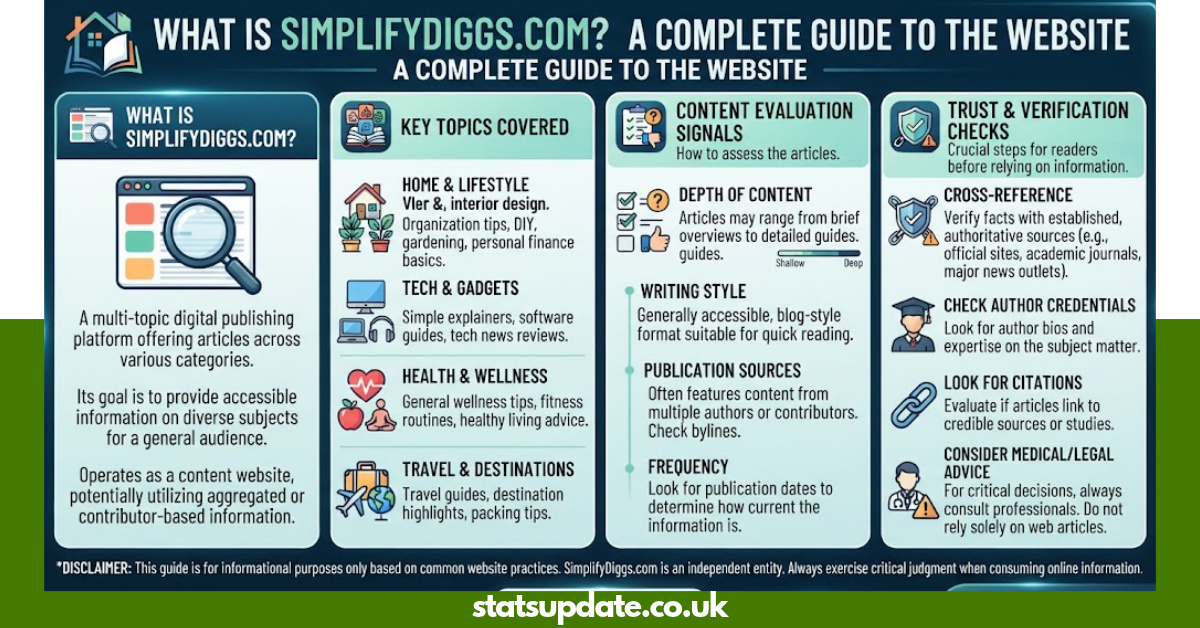
Finding useful information online can become difficult when a website covers many subjects without clearly explaining its purpose. simplifydiggs com has attracted attention as a multi-topic publishing website, but readers may still ask what it offers, which subjects it covers, and how they should evaluate its information. This guide breaks down the platform, its likely use cases, content signals, trust checks, and practical ways to use it responsibly.
What Is SimplifyDiggs Com?
simplifydiggs com appears to be a general-interest content website rather than a single-purpose application, marketplace, or software platform. Search-indexed references describe articles associated with technology, business, productivity, lifestyle, travel, automotive subjects, and other informational categories.
However, an important verification point matters: the official simplifydiggs.com homepage could not be independently fetched during this review because it returned a 403 response. Therefore, readers should distinguish between information visible on the web about the domain and information that the website itself currently confirms.
For unfamiliar websites, that distinction is valuable. A clear description of a site’s purpose should ideally come from the publisher itself through pages such as About, Contact, editorial policies, author profiles, and individual article pages.
What Does SimplifyDiggs Com Cover?
Available indexed material associates the website with a broad range of subjects. These can include:
- Technology and digital tools
- Business and workplace topics
- Productivity
- Lifestyle
- Travel
- Automotive information
- Home and everyday-interest subjects
- Digital trends
- General how-to information
This broad approach can help readers discover different topics from one publication. At the same time, broad coverage makes article-level verification more important because expertise can vary substantially between subjects.
SimplifyDiggs Com Content Areas
| Content area | Possible reader intent | What to check |
| Technology | Understand tools, apps, software, and digital trends | Technical accuracy and publication date |
| Business | Learn concepts and workplace practices | Data sources and author background |
| Productivity | Find practical methods and ideas | Whether recommendations include evidence |
| Lifestyle | Explore everyday topics | Context, freshness, and source quality |
| Travel | Research destinations and planning ideas | Current prices, rules, and official sources |
| Automotive | Learn about vehicles and ownership | Specifications and manufacturer sources |
| Home | Find practical household information | Safety considerations and expert guidance |
| Digital trends | Understand changing online behavior | Dates, data, and original research |
The table should be treated as a practical framework rather than a claim that every category is currently active or equally developed on the website.
Who May Find SimplifyDiggs Com Useful?
The platform may appeal to readers who prefer straightforward articles rather than highly technical publications. A general-interest site can work well for early-stage research, topic discovery, definitions, and basic explanations.
For more consequential decisions, readers should move beyond a single article. Google recommends content that demonstrates clear sourcing, expertise, authorship, originality, and a satisfying experience for the reader.
A useful research process is:
- Read the article to understand the subject.
- Identify important factual claims.
- Check the author’s background.
- Follow cited sources.
- Compare important information with primary sources.
- Check the publication or update date.
- Make the final decision using verified evidence.
How to Evaluate SimplifyDiggs Com Content
When reading simplifydiggs com, do not judge an article only by its appearance or search position. Evaluate the actual information presented on the page.
1. Check the Author
Look for a named author and a meaningful author profile. A useful profile should explain relevant experience rather than simply display a name.
Google specifically encourages publishers to make it clear who created content and recommends accurate bylines where readers would reasonably expect them.
2. Check the Sources
A strong article should make important claims easy to verify. Look for links to original research, government agencies, manufacturers, academic institutions, official documentation, or other authoritative primary sources.
Avoid treating an unsourced statement as established fact simply because it appears in an article.
3. Check the Date
Information changes quickly in technology, travel, finance, automotive topics, software, and online services.
Before relying on an article, check:
- Original publication date
- Last updated date
- Whether the referenced product or service still exists
- Whether prices or policies have changed
- Whether official documentation has been updated
4. Look for First-Hand Experience
First-hand information can make an article more useful when the subject involves a product, service, destination, or practical process.
Google’s guidance specifically highlights first-hand expertise as an important aspect of people-first content.
For example, a product review becomes more informative when it explains what was tested, how it was tested, and what evidence supports the observations.
Is SimplifyDiggs Com a Reliable Source?
Reliability should be assessed article by article, especially when a website publishes across many unrelated subjects.
A page becomes easier to trust when it provides:
- A clear author
- Relevant author expertise
- Accurate publication information
- Direct source links
- Original observations or research
- Transparent methodology
- Specific evidence
- Corrections when errors occur
- Clear editorial or contact information
Google’s guidance describes trust as the most important aspect of E-E-A-T, while experience, expertise, and authoritativeness contribute to that overall trust.
That does not mean a website needs to demonstrate every signal on every page. The appropriate evidence depends on the topic and the potential impact of the information.
How Should You Use SimplifyDiggs Com for Research?
simplifydiggs com can be approached as a starting point for learning about a subject rather than an automatic final authority.
For low-risk subjects, a clear introductory article may provide enough context to understand basic terminology or identify questions worth researching.
For important subjects, use a layered verification process.
A Practical Verification Method
Step 1: Understand the claim
Write down exactly what the article says.
Step 2: Find the original source
If the article discusses a statistic, regulation, product specification, study, or announcement, locate the original source.
Step 3: Compare dates
Make sure the original source is still current.
Step 4: Compare multiple authoritative sources
Look for agreement or meaningful differences.
Step 5: Separate facts from recommendations
A factual statement and a recommendation are not the same thing.
Step 6: Make your own assessment
Use verified information rather than relying solely on the article’s wording.
This approach aligns with Google’s people-first guidance, which emphasizes substantial value, original information, reliable sourcing, and content created to help readers rather than manipulate rankings.
SimplifyDiggs Com and Google Search
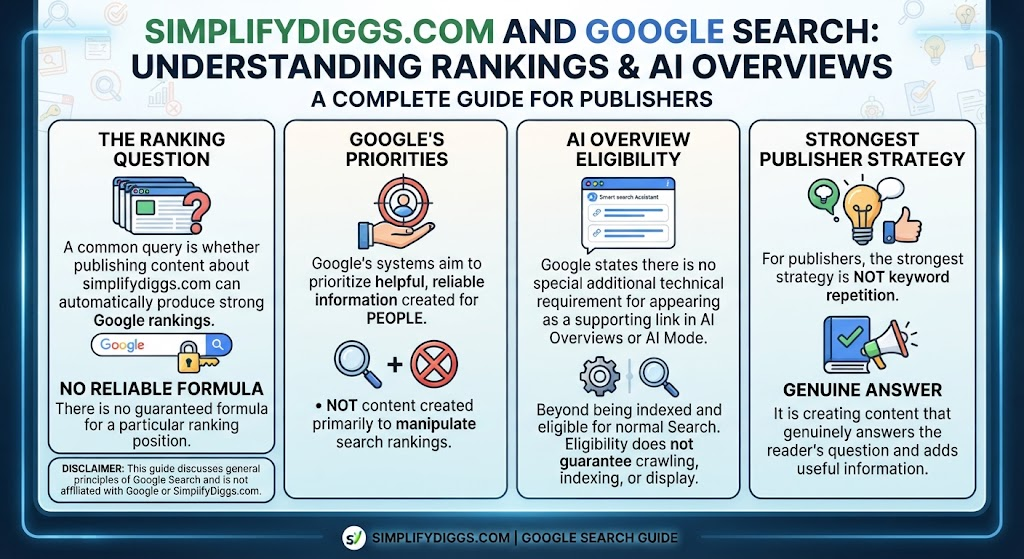
A common question is whether publishing content about simplifydiggs com can automatically produce strong Google rankings.
There is no reliable formula that guarantees a particular ranking position. Google states that its systems aim to prioritize helpful, reliable information created for people rather than content created primarily to manipulate search rankings.
Google also says there is no special additional technical requirement for appearing as a supporting link in AI Overviews or AI Mode beyond being indexed and eligible for normal Search, although eligibility does not guarantee that Google will crawl, index, or display a page.
For publishers, that means the strongest strategy is not keyword repetition. It is creating content that genuinely answers the reader’s question and adds useful information.
How SimplifyDiggs Com Content Can Become More Helpful
If the website aims to strengthen its editorial value, several elements can make individual articles more useful.
Strong Author Pages
Author profiles should explain relevant experience and connect writers to the subjects they cover.
Clear Editorial Standards
A visible editorial policy can explain how the publication researches, reviews, updates, and corrects content.
Original Research
Articles can add value through original comparisons, testing, interviews, data analysis, screenshots, examples, or documented first-hand observations.
Better Source Transparency
Important claims should connect directly to the original evidence.
Clear Update History
Readers benefit when an article explains what changed during an update instead of simply changing the date.
Topic-Specific Expertise
A broad publication can still demonstrate expertise by using qualified contributors or reviewers for specialist subjects.
These improvements correspond closely with Google’s guidance around authorship, sourcing, originality, first-hand experience, and the “Who, How, and Why” framework.
What Makes Content Useful for AI Overviews and AI Search?
Google’s current guidance for generative AI search emphasizes many of the same fundamentals used for traditional Search.
Google recommends creating unique, valuable, reliable, people-first content instead of producing large quantities of repetitive pages designed primarily to capture search variations.
For an article about simplifydiggs com, this means answering the main question directly and then covering the related questions readers naturally ask.
Useful supporting sections include:
- What is the website?
- What does it publish?
- Who is it for?
- What topics does it cover?
- How can readers verify its information?
- What should readers check before relying on an article?
- What sources should readers use for important claims?
This structure helps both readers and search systems understand the subject without forcing the same keyword into every paragraph.
SimplifyDiggs Com: Quick Facts Table
| Question | Answer |
| What is simplifydiggs com? | It appears to be a broad informational publishing website. |
| Is it a software application? | Available evidence does not establish it as an application. |
| What subjects are associated with it? | Technology, business, productivity, lifestyle, travel, automotive, and other general topics. |
| Is it a specialist publication? | Its broad subject coverage means it should not automatically be treated as a specialist source. |
| Can readers use its articles for research? | Yes, as an initial information source, while important claims should be independently verified. |
| Should readers check article dates? | Yes, especially for changing subjects. |
| Should readers check authors? | Yes. Author identity and relevant experience help readers assess trust. |
| Does Google guarantee rankings for helpful content? | No. Helpful content is important, but Google does not guarantee indexing or rankings. |
| Does Google require special AI-SEO tricks? | Google says foundational SEO and valuable, people-first content remain the key approach for AI search. |
What Should Readers Check Before Trusting an Article?
A simple checklist can prevent many research mistakes.
Reader Trust Checklist
Author
- Is the writer identified?
- Does the writer have relevant experience?
Evidence
- Does the article cite original sources?
- Can important claims be independently verified?
Freshness
- Is the information current?
- Has the subject changed since publication?
Purpose
- Is the article primarily educational?
- Does it clearly separate facts from recommendations?
Originality
- Does it provide something beyond information already available elsewhere?
- Does it include original examples, research, testing, or observations?
Transparency
- Can readers find information about the publisher?
- Are corrections or updates explained?
These checks are especially important for financial, medical, legal, safety, and other high-impact subjects.
Why Primary Sources Matter
Primary sources give readers the closest available connection to the underlying evidence.
For example:
- Technology claims → official manufacturer or developer documentation
- Government rules → government websites
- Research claims → original academic paper
- Product specifications → manufacturer documentation
- Company announcements → official company newsroom
- Search guidance → Google Search Central
This approach reduces the risk of repeating outdated or incorrectly summarized information.
For Google Search itself, Google recommends focusing on original information and meaningful additional value instead of simply rewriting material found elsewhere.
Common Mistakes When Researching SimplifyDiggs Com
Readers can avoid several common errors when investigating an unfamiliar website.
Mistake 1: Treating Search Position as Proof
A high search position does not automatically establish expertise or accuracy.
Mistake 2: Trusting Every Article Equally
A website can publish useful material on one subject and less authoritative material on another.
Mistake 3: Ignoring Publication Dates
Old information can become misleading when products, regulations, prices, or services change.
Mistake 4: Repeating Claims Without Checking Sources
An article that cites another article is not necessarily evidence of the original claim.
Mistake 5: Assuming SEO Means Authority
SEO improves discoverability. It does not replace evidence, experience, expertise, or transparent sourcing.
A Better Content Strategy for SimplifyDiggs Com
If the goal is to build a stronger publication, simplifydiggs com can focus on depth rather than simply increasing the number of pages.
A practical strategy would include:
- Choose clearly defined audience needs.
- Build topic clusters around genuine reader questions.
- Assign specialist topics to knowledgeable writers.
- Add author biographies.
- Cite original sources.
- Include first-hand research where appropriate.
- Update changing information.
- Remove unsupported claims.
- Add useful visuals and examples.
- Measure reader satisfaction rather than focusing only on search traffic.
Google’s current generative-AI guidance specifically encourages unique, valuable, non-commodity content and warns against creating many pages primarily to manipulate rankings or AI visibility.
Frequently Asked Questions
Answer: simplifydiggs com appears to be a general-interest online publishing website covering multiple informational subjects. Available indexed references associate it with areas such as technology, business, productivity, lifestyle, travel, automotive, and other topics.
Answer: Technology appears to be among the subjects associated with the domain, but its broader content footprint means it should not automatically be classified as a technology-only publication.
Answer: Website safety and content reliability are separate questions. Readers should check the site’s connection, avoid entering sensitive information unnecessarily, and independently verify important claims before relying on them.
Answer: You can use its available articles as an initial source for understanding topics and discovering useful questions. For important decisions, verify key claims through authoritative primary sources.
Answer: Check the author, publication date, sources, evidence, methodology, and original information. Google recommends clear authorship, relevant expertise, reliable sourcing, and content that demonstrates real value to readers.
Answer: No. Google explains that helpful, reliable, people-first content is important, but meeting its guidance does not guarantee crawling, indexing, visibility, or a particular ranking.
Conclusion
simplifydiggs com can be approached as a broad informational publishing domain associated with multiple everyday and digital topics. The most useful way to assess any article is to look beyond the domain name and examine its author, evidence, sources, date, originality, and practical value.
For readers, the safest approach is simple: use accessible articles to understand a topic, then verify important claims against authoritative primary sources. For publishers, the clearest path to long-term search visibility is equally practical—create original, well-sourced, people-first content that genuinely satisfies the reader’s question. Google continues to emphasize these principles across traditional Search and its AI-powered search experiences.