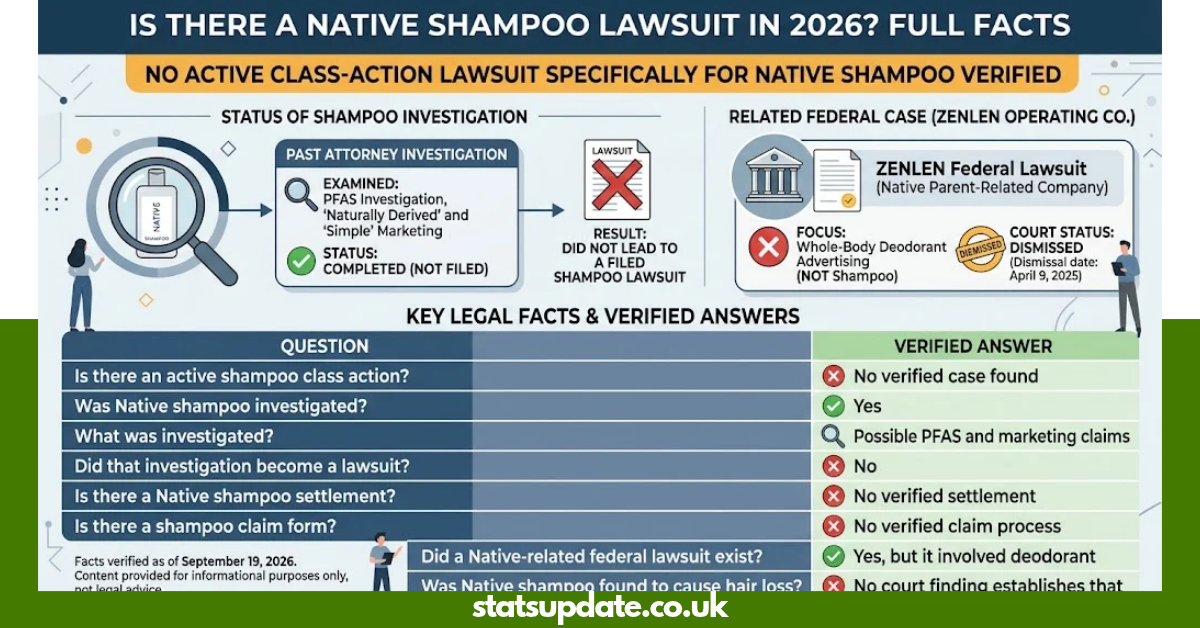
There is no verified active class-action lawsuit specifically against Native shampoo in the primary sources reviewed for this article as of September 19, 2026. An attorney investigation examined whether certain Native personal-care products could contain PFAS despite “naturally derived” and “simple” marketing, but the investigation is marked complete and did not result in a filed shampoo lawsuit.
A separate federal lawsuit involving Native’s parent-related operating company, Zenlen, concerned whole-body deodorant advertising, not shampoo. The court dismissed that case on April 9, 2025.
| Question | Verified answer |
| Is there an active shampoo class action? | No verified case found |
| Was Native shampoo investigated? | Yes |
| What was investigated? | Possible PFAS and marketing claims |
| Did that investigation become a lawsuit? | No |
| Is there a Native shampoo settlement? | No verified settlement |
| Is there a shampoo claim form? | No verified claim process |
| Did a Native-related federal lawsuit exist? | Yes, but it involved deodorant |
| Was Native shampoo found to cause hair loss? | No court finding establishes that |
What Is the Native Shampoo Lawsuit About?
The phrase native shampoo lawsuit largely comes from an attorney-led investigation into Native personal-care products. ClassAction.org says attorneys examined whether certain Native products contained PFAS, often called “forever chemicals,” despite marketing involving naturally derived and simple ingredients. The page now states that the investigation is complete.
That distinction matters. An investigation does not mean a company has been sued, found liable, or ordered to pay consumers.
The investigation focused on a potential consumer-protection theory: if a product was promoted using particular ingredient or “clean” claims, lawyers could examine whether the actual formulation supported those messages.
Key facts at a glance
- Brand: Native
- Parent company: Procter & Gamble
- Issue investigated: Possible PFAS and product-marketing claims
- Investigation: Completed
- Filed shampoo lawsuit: No verified filing found
- Court judgment against Native shampoo: None identified
- Shampoo settlement: None identified
- Consumer payout: None identified
When Did the Native Shampoo Investigation Start?
The investigation became public as consumers and attorneys raised questions about Native’s ingredient marketing. The investigation page described concerns involving Native personal-care products and possible PFAS content.
The legal theory centered on whether marketing terms such as “naturally derived” and “simple” could create a different impression from the actual ingredients or formulation.
This is different from proving that a particular product caused an injury. A consumer-marketing investigation can examine labeling and advertising without establishing medical causation.
What Happened to the PFAS Investigation?
The investigation is now marked “Investigation Complete.” ClassAction.org says attorneys working with the organization finished their investigation and that the original page is now maintained for reference.
The available primary material does not announce a filed complaint, class certification, settlement, or consumer compensation program resulting from that investigation.
That means readers should not treat an old investigation page as proof that a current lawsuit exists.
Investigation vs. lawsuit
| Legal stage | What it means |
| Consumer complaint | A person reports a concern |
| Attorney investigation | Lawyers examine whether a legal case may exist |
| Complaint filed | A lawsuit officially begins in court |
| Class certification | A court decides whether the case can proceed as a class action |
| Settlement | Parties agree to resolve claims, usually subject to court approval |
| Judgment | A court enters a final decision |
The Native shampoo matter did not reach the later court stages described above in the primary source reviewed.
Are PFAS Actually Used in Cosmetics?
PFAS are a real group of synthetic chemicals, and the FDA has studied their use in cosmetics. However, the existence of PFAS in some cosmetics does not establish that Native shampoo contains PFAS.
The FDA’s December 2025 assessment identified 51 PFAS intentionally added to 1,744 cosmetic formulations based on cosmetic product listing data. The agency also said significant data gaps remain for many PFAS, including limited information about exposure and toxicity.
This distinction is important when reading online claims:
PFAS exist in some cosmetics → does not mean Native shampoo contains PFAS → and does not prove Native shampoo causes illness or hair loss.
Consumers should look for product-specific testing or official regulatory findings rather than assuming that a general PFAS report applies to one brand.
Did Native Shampoo Cause Hair Loss?
There are online consumer reports describing shedding, thinning, dryness, itching, or scalp irritation after using Native hair products. However, personal reports do not by themselves establish that Native shampoo caused those symptoms.
The primary legal and regulatory sources reviewed for this article do not establish a court finding that Native shampoo causes hair loss.
Hair shedding can have many causes, including changes in hormones, stress, nutrition, illness, medications, genetics, scalp conditions, and changes in hair-care routines. A person experiencing persistent or significant hair loss should discuss it with a qualified healthcare professional rather than assuming that one product is responsible.
What evidence would matter?
A stronger product-safety claim would normally require evidence such as:
- Product-specific laboratory testing
- Clearly identified product batches or lots
- Reproducible test results
- Reliable exposure information
- Medical documentation where injury is alleged
- Evidence connecting the product to the claimed effect
- A documented regulatory or court finding
Online comments can raise questions, but they cannot replace this type of evidence.
What Did the Native Advertising Review Find?
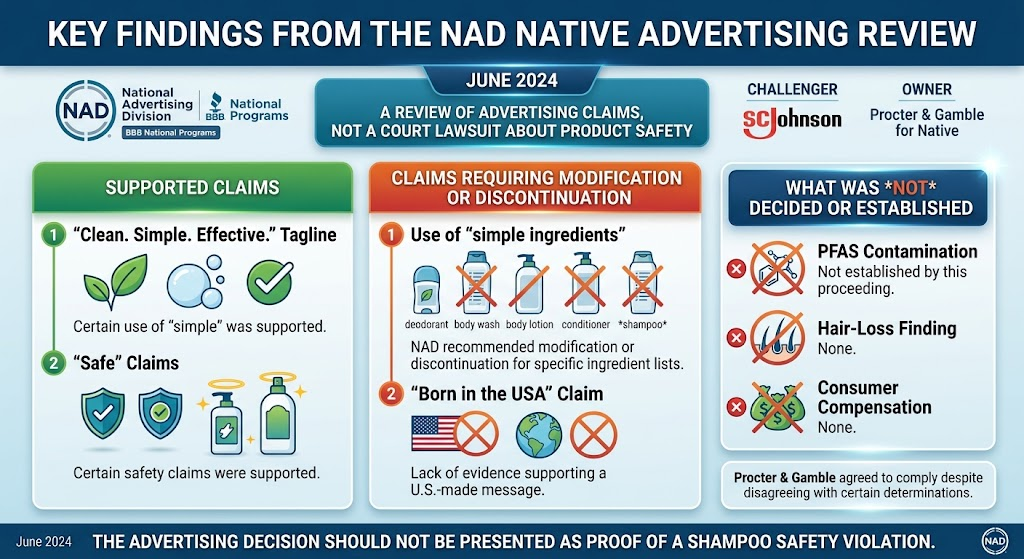
A separate matter involving Native’s advertising was handled by the National Advertising Division (NAD) of BBB National Programs. This was not a court lawsuit.
In June 2024, NAD reviewed claims made by Procter & Gamble for Native personal-care products after a challenge from SC Johnson. NAD found some claims supported but recommended that P&G modify or discontinue the use of “simple ingredients” when describing Native deodorants, body washes, body lotion, conditioners, and shampoos.
NAD also recommended discontinuing the “Born in the USA” claim because P&G did not provide evidence supporting the message that Native products were made in the United States under the applicable standard. P&G said it disagreed with certain determinations but agreed to comply with the recommendations.
What NAD did and did not decide
| Issue | NAD finding |
| “Clean. Simple. Effective.” tagline | Certain use of “simple” was supported |
| “Simple ingredients” for Native shampoo | Recommended modification or discontinuation |
| “Safe” claims | Certain claims were supported |
| “Born in the USA” | Recommended discontinuation |
| PFAS contamination finding | Not established by this proceeding |
| Hair-loss finding | None |
| Consumer compensation | None |
So, the advertising decision should not be presented as proof of a shampoo safety violation.
What Was the Native Deodorant Lawsuit?
Another source of confusion is a real federal lawsuit involving Native whole-body deodorant.
In Hernandez v. Zenlen, Inc., a plaintiff brought a proposed class action concerning advertising that Native deodorant provided “clinically proven 72-hour odor protection.” The case was filed in the U.S. District Court for the Southern District of New York.
On April 9, 2025, Judge Denise L. Cote granted Zenlen’s motion to dismiss the amended complaint and directed the clerk to enter judgment for the defendant and close the case.
This case is important because online articles sometimes combine the deodorant lawsuit with the separate shampoo PFAS investigation.
They were not the same legal matter.
Native legal matters compared
| Matter | Product | Type | Status |
| PFAS investigation | Shampoo and other Native products | Attorney investigation | Complete |
| NAD advertising review | Shampoo and other Native products | Advertising self-regulation | 2024 decision |
| Hernandez v. Zenlen | Whole-body deodorant | Federal proposed class action | Dismissed April 9, 2025 |
Keeping these matters separate prevents misleading conclusions about the native shampoo lawsuit search term.
Is There a Native Shampoo Settlement in 2026?
There is no verified Native shampoo settlement or official consumer claim program identified in the primary sources reviewed for this article.
That means consumers should be cautious with websites advertising phrases such as:
- “Native shampoo settlement claim”
- “Native shampoo lawsuit payout”
- “Native PFAS settlement check”
- “Native shampoo claim form”
- “You may be eligible for $X”
A genuine class-action settlement normally identifies the court, case name, case number, settlement administrator, eligibility requirements, deadlines, and court-approved documents.
If a page asks for personal information or payment but does not provide verifiable case details, stop and verify the information independently.
Can You File a Claim Against Native Shampoo?
There is currently no verified Native shampoo settlement claim process identified in the primary sources reviewed.
That does not prevent an individual from seeking legal advice about a separate personal situation. A person who believes a product caused a documented injury can preserve evidence and speak with a qualified attorney about applicable laws and deadlines.
Keep these records
If you experienced a problem after using a cosmetic product, consider keeping:
- The product bottle or packaging.
- Photos of the label and ingredient list.
- Lot or batch information.
- Purchase receipts.
- The date you started and stopped using it.
- Photos documenting a visible reaction, when appropriate.
- Medical records related to the problem.
- The exact product name and scent.
- Any communication with the manufacturer or retailer.
Good records make it easier to establish exactly what product was used and when.
What Should Native Shampoo Buyers Check?
Consumers who want to evaluate Native shampoo can start with the product label rather than social-media claims.
The FDA explains that retail cosmetics generally must list ingredients in descending order of predominance, subject to applicable labeling rules. The agency also provides information about cosmetic ingredients and potential contaminants.
A simple checking process
Step 1: Identify the exact product.
Write down the shampoo name, scent, size, and lot information.
Step 2: Read the current ingredient list.
Do not rely only on an old screenshot because formulations and packaging can change.
Step 3: Check official information.
Compare the product information with FDA guidance and the manufacturer’s current information.
Step 4: Separate allegations from findings.
A TikTok post, complaint, investigation, court filing, and court judgment are different things.
Step 5: Document adverse reactions.
If you experience persistent irritation or another health problem, stop using the product if appropriate and seek professional medical advice.
What Does the FDA Say About Cosmetic Safety?
The FDA’s current PFAS information shows why this subject deserves careful attention without jumping to conclusions.
The agency says PFAS are used in some cosmetic products for properties such as conditioning, smoothing, appearance, texture, and consistency. It also notes that PFAS may sometimes occur unintentionally because of impurities or chemical breakdown.
However, the FDA’s 2025 assessment did not establish a universal safety conclusion for every PFAS used in cosmetics. The agency reported substantial data gaps and said the safety of most PFAS evaluated could not be definitively established.
That means a general discussion about PFAS should not be turned into a product-specific accusation without product-specific evidence.
How Can You Spot Fake Native Lawsuit Information?
Search traffic around legal topics can attract misleading pages. A useful first check is whether a page provides evidence that can be independently verified.
Be cautious when a page:
- Does not name a court.
- Does not provide a case number.
- Calls an attorney investigation a lawsuit.
- Promises a specific payout without a settlement order.
- Uses dramatic claims without laboratory evidence.
- Mixes shampoo, deodorant, and unrelated Native disputes.
- Says consumers can “claim money” without identifying a settlement administrator.
- Uses an old investigation page as proof of a current lawsuit.
A trustworthy legal update should clearly identify what happened, when it happened, and which official source supports the statement.
What Does the Evidence Mean for Consumers?
The current evidence supports a careful interpretation.
There was an attorney investigation involving Native products and potential PFAS-related marketing concerns. That investigation is now marked complete.
There was also a separate federal lawsuit involving Native deodorant advertising, but the court dismissed the amended complaint in April 2025.
And there was an advertising review involving Native shampoo and other personal-care products, where NAD recommended changes to certain “simple ingredients” and “Born in the USA” claims.
None of those facts establish that Native shampoo causes hair loss or that consumers are currently entitled to a shampoo settlement.
Native Shampoo Lawsuit Status: Complete Timeline
| Date | Event | What it means |
| 2024 | NAD reviewed Native advertising | Separate advertising matter |
| June 2024 | Native deodorant federal case filed | Real court case, but deodorant |
| June 27, 2024 | NAD issued its Native decision | Certain claims supported; others recommended for modification |
| April 9, 2025 | Hernandez v. Zenlen dismissed | Deodorant case closed |
| 2025 | Native PFAS investigation completed | No resulting shampoo lawsuit identified |
| Dec. 29, 2025 | FDA published PFAS cosmetics assessment | General cosmetics information, not a Native-specific finding |
| Sept. 19, 2026 | Current review | No verified active Native shampoo class action identified |
Frequently Asked Questions
No verified active class-action lawsuit specifically involving Native shampoo was identified in the primary sources reviewed as of September 19, 2026. The earlier PFAS investigation is marked complete.
Yes. Attorneys investigated whether certain Native personal-care products could contain PFAS despite marketing involving naturally derived and simple ingredients. ClassAction.org now lists that investigation as complete.
No. The primary sources reviewed do not show a court ruling establishing that Native shampoo causes hair loss.
No verified settlement claim form was identified. The completed investigation does not provide an active compensation program.
Yes, but the documented federal lawsuit involved Native whole-body deodorant advertising rather than shampoo. The court dismissed the amended complaint on April 9, 2025.
That is an individual product and health decision. If a shampoo causes you irritation or another persistent problem, consider stopping use and speaking with a qualified healthcare professional. For legal concerns, preserve your product records and consult a qualified attorney about your specific circumstances.
Conclusion
The native shampoo lawsuit story needs careful fact-checking because several different Native-related matters have been combined online. The verified record shows a completed PFAS investigation, a separate advertising review involving Native shampoo and other products, and a separate federal deodorant lawsuit that was dismissed in 2025.
For consumers, the most useful step is to separate allegations, investigations, regulatory decisions, and court judgments. If a new lawsuit or settlement is announced, verify it through the court record, official settlement documents, or the relevant government or regulatory source before submitting personal information.