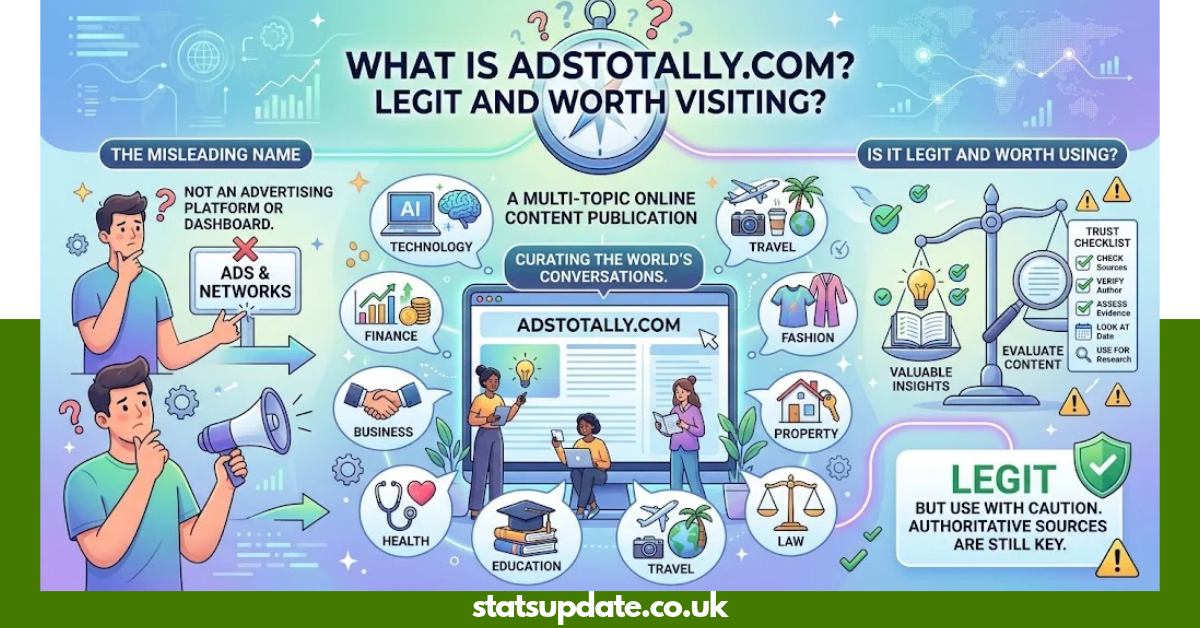
If you searched for adstotally.com expecting an advertising dashboard, campaign manager, or publisher network, the website may not match that expectation. Current public information presents it primarily as a general-interest publication covering several areas rather than as a conventional advertising technology platform.
The site’s visible positioning uses the phrase “Curating the World’s Conversations,” while its content spans categories such as technology, finance, business, health, education, lifestyle, travel, fashion, property, and law.
That distinction matters because a website can display advertisements without being an advertising network. A normal publication may earn money from ads shown to its readers, while an ad network typically provides tools for advertisers, publishers, targeting, campaign management, reporting, and payments.
Is AdsTotally.com an Advertising Network?
Short answer: Current public evidence does not establish AdsTotally.com as a conventional advertising network.
A traditional advertising platform usually gives users a clear way to create campaigns, choose targeting, manage budgets, view reports, or manage publisher earnings. Reviews of the currently visible site have not identified a conventional advertiser dashboard, campaign builder, or publisher payout system.
The distinction can be summarized like this:
| Feature | AdsTotally.com as currently observed | Typical Ad Network |
| Editorial articles | Yes | Usually not the main function |
| Multiple content categories | Yes | Not normally the core product |
| Advertiser campaign dashboard | Not publicly verified | Usually expected |
| Publisher earnings dashboard | Not publicly verified | Usually expected |
| Audience targeting tools | Not publicly verified | Common |
| Campaign budget controls | Not publicly verified | Common |
| Editorial content | Major part of the site | Usually secondary |
| Display advertising | Reported on pages | Core business function |
For that reason, someone searching for an alternative to an advertising-management service should verify the actual service offered before creating an account or sending payment.
Why Does the Name Create Confusion?
The name adstotally.com naturally sounds connected to advertising. A reader could reasonably assume that it offers PPC campaigns, display ads, publisher monetization, or marketing software.
The site’s visible structure tells a different story. It resembles a broad online publication, with informational articles and multiple subject categories.
This is an important SEO lesson too: a domain name alone does not prove what a website does. The homepage, About page, service pages, author information, policies, and actual user-facing tools provide stronger evidence.
What Topics Does AdsTotally.com Cover?
The website has a broad editorial scope rather than one tightly defined niche.
Commonly identified areas include:
- Technology
- Business
- Finance
- Health
- Education
- Fashion
- Travel
- Lifestyle
- Real estate
- Home improvement
- Law
- General-interest subjects
This broad approach can help readers discover information across different interests. However, it also means readers should pay closer attention to author credentials and source quality when an article covers a specialist subject.
For health, financial, legal, or other high-impact topics, the safest approach is to use specialist organizations and primary sources to confirm important claims.
How Should You Check Whether AdsTotally.com Is Trustworthy?
There is no single button that can prove whether an entire publication is trustworthy.
Instead, evaluate each page using a simple checklist:
- Check the author. Look for a real byline and relevant background.
- Check the date. Information can become outdated quickly.
- Check the sources. Prefer government agencies, universities, regulators, companies, research institutions, and original documents.
- Check the evidence. Strong claims should have supporting evidence.
- Check the purpose. Understand whether the page is informational, commercial, sponsored, or affiliate content.
- Check important claims elsewhere. Do not rely on one website for major decisions.
Google’s guidance emphasizes clear authorship, first-hand expertise where relevant, original information, reliable sourcing, and content created primarily to help people.
Is AdsTotally.com Safe to Visit?
A website’s existence does not automatically tell you whether every link, advertisement, download, or third-party destination is safe.
If you visit adstotally.com, use normal web-safety habits:
- Keep your browser updated.
- Avoid unexpected downloads.
- Do not enter payment details on unfamiliar pages.
- Check the domain carefully before entering credentials.
- Be cautious with pop-ups and redirects.
- Do not install browser extensions prompted by advertisements.
- Verify important commercial claims independently.
Third-party advertisements can lead away from the original publication. Therefore, readers should judge the destination website separately from the article they were reading.
Can AdsTotally.com Be Used for SEO or Guest Posts?
This requires more care than simply looking at domain metrics.
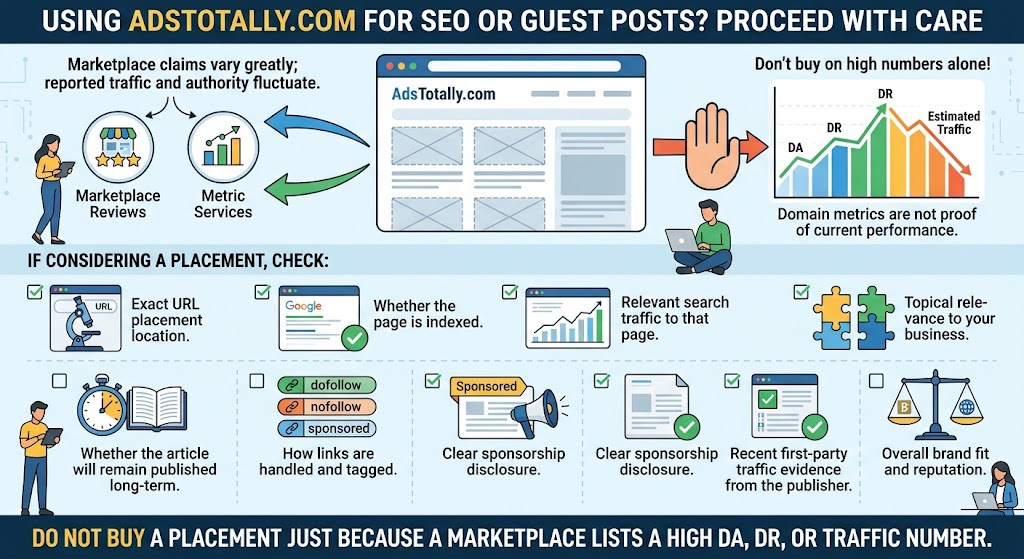
Third-party marketplace and review pages have associated adstotally.com with guest-post opportunities, but publicly reported traffic and authority figures vary substantially between sources and dates. That makes any single third-party SEO metric unsuitable as proof of current performance.
If you are considering a paid placement, check:
- The exact URL where your article will appear.
- Whether that page is indexed.
- Whether the page receives relevant search traffic.
- The site’s topical relevance to your business.
- Whether the article will remain published.
- How links are handled.
- Whether sponsored content is disclosed.
- Whether the publisher provides recent first-party traffic evidence.
- Whether the placement fits your brand.
Do not buy a placement simply because a marketplace lists a high DA, DR, or traffic number.
Does a High Domain Metric Prove SEO Value?
No.
Domain-level metrics can be useful for prospecting, but they do not prove that a specific article will rank or send referral traffic.
A site might have a strong-looking domain score while individual pages receive little search visibility. Conversely, a relevant article on a smaller site can still attract useful readers if the page matches a real search need.
Google’s Search guidance focuses on helpful, reliable, people-first content rather than tactics designed mainly to manipulate rankings.
What Should an SEO Buyer Verify?
| SEO Check | Why It Matters |
| Page-level organic traffic | Shows whether actual pages attract search visitors |
| Relevant topical content | Helps ensure the audience matches your subject |
| Indexed pages | Confirms Google can find the content |
| Author information | Supports transparency and trust |
| Outbound-link practices | Helps identify how paid placements are handled |
| Recent publishing activity | Shows whether the site remains active |
| First-party analytics | Stronger evidence than marketplace estimates |
| Article permanence | Important for long-term value |
| Referral traffic | Shows whether real readers may visit your site |
What About AdsTotally.com Traffic Claims?
Traffic figures deserve careful interpretation.
One 2026 Ranktracker review reported an estimated 3,900 monthly organic visits for the domain, while other marketplace listings reported very different figures. Those measurements come from third-party tools and should not be treated as verified Google Analytics or Search Console data.
This difference is a useful reminder: SEO tools estimate traffic using their own databases and models.
Before paying for a placement, ask for recent evidence such as:
- Google Search Console performance screenshots
- Google Analytics traffic reports
- Top landing pages
- Search queries
- Country breakdown
- Organic traffic trends
- Referral traffic
A large domain-level number means little if the page containing your article receives almost no visitors.
Is AdsTotally.com Useful for Readers?
It can be useful for discovering general-interest information, especially when you want to explore topics across several categories.
However, broad publications should not automatically replace specialist sources.
For example, a technology article may be useful for learning basic concepts, while a medical claim should be checked against a recognized medical institution. A financial claim should be checked against the relevant regulator, financial institution, or original filing.
The best approach is to use adstotally.com as one information source and verify important claims through authoritative sources.
How Can You Tell If an Article Is High Quality?
Use the Who, How, and Why test.
Who Created It?
Look for:
- A named author
- Relevant experience
- Author profile
- Editorial information
- Clear publication or update date
Google specifically recommends making authorship clear where readers would expect it and providing useful background about the author.
How Was It Created?
Ask whether the article appears to contain original research, first-hand experience, data, examples, or meaningful analysis.
An article that simply repeats information found elsewhere gives readers less value than one that adds new evidence or explains the subject clearly.
Why Was It Created?
The strongest reason should be to help the reader.
Google says content created primarily to manipulate search rankings is not aligned with its people-first approach.
How Does AdsTotally.com Fit Google AI Search?
Google says the same fundamental SEO principles apply to AI Overviews and AI Mode: pages should meet normal Search requirements and provide helpful, reliable, people-first information. There is no separate shortcut that guarantees inclusion in an AI feature.
For a page about adstotally.com, that means answering the main questions directly:
- What is it?
- What does it offer?
- Is it an ad network?
- What topics does it cover?
- Is it useful for readers?
- How should users evaluate its trustworthiness?
- What should SEO buyers verify?
- Which claims are confirmed and which are estimates?
Clear answers make a page easier for both people and search systems to understand.
Should You Trust Paid Reviews and Sponsored Content?
Treat sponsored material differently from independent editorial information.
If a publisher receives money, products, commissions, or another material benefit connected to an endorsement, disclosure can matter. The U.S. Federal Trade Commission says material connections should be disclosed clearly and conspicuously when they could affect how consumers evaluate an endorsement.
For publishers, a transparent approach can include labels such as:
- Sponsored
- Paid partnership
- Advertisement
- Affiliate link
The exact disclosure depends on the relationship and applicable rules.
AdsTotally.com vs. a Traditional Advertising Platform
The difference becomes clearer when the two models are placed side by side.
| Area | AdsTotally.com | Traditional Ad Platform |
| Main purpose | Content publication | Advertising technology/service |
| Reader articles | Central feature | Usually not central |
| Campaign creation | Not publicly verified | Standard feature |
| Publisher dashboard | Not publicly verified | Standard feature |
| Audience targeting | Not publicly verified | Common |
| Editorial categories | Broad | Usually not the core product |
| Search content | Important | Usually secondary |
| Reader-focused publishing | Yes | Usually no |
| Advertising infrastructure | Not established as the main public product | Core function |
This comparison explains why the domain name can be misleading without requiring the site itself to be an advertising platform.
What Should Businesses Check Before Using AdsTotally.com?
If you are evaluating the website for marketing, publishing, or SEO purposes, follow this practical process.
Step 1: Define Your Goal
Decide whether you want:
- Brand awareness
- Referral traffic
- A sponsored article
- A guest post
- A brand mention
- Audience exposure
- Content distribution
Your goal determines what evidence matters.
Step 2: Inspect the Exact Page
Do not judge a placement only from the homepage.
Review similar articles and check whether they have:
- Search visibility
- Comments or engagement
- Internal links
- Relevant readers
- Recent updates
- Clear authorship
Step 3: Request First-Party Evidence
If someone is selling traffic or exposure, ask for recent evidence.
A screenshot from Google Search Console or Analytics is more useful than a vague claim about “huge traffic.”
Step 4: Review Link Terms
Clarify:
- Follow or nofollow status
- Sponsored attributes
- Number of links
- Anchor-text rules
- Article permanence
- Editing rights
- Content requirements
Step 5: Check Disclosure Practices
If the content is paid, make sure readers can understand its commercial nature.
This protects transparency and helps avoid confusing advertising with independent editorial coverage.
What Are the Main Red Flags to Watch?
A careful buyer should slow down when a seller provides:
- Very high traffic with no first-party evidence
- Large SEO metrics but little page-level visibility
- Unclear ownership information
- No author information
- Repeated or thin articles
- Irrelevant outbound links
- Guaranteed rankings
- Guaranteed Google traffic
- Claims of guaranteed AI Overview placement
- Pressure to pay immediately
- Unclear sponsored-content policies
No legitimate SEO provider can guarantee a specific Google ranking position. Google itself notes that meeting Search requirements and best practices does not guarantee crawling, indexing, or serving a page in Search or AI features.
What Are the Benefits and Limitations?
Potential Benefits
- Broad topic coverage
- Easy access to general-interest content
- Potential publishing opportunities
- Multiple categories for content discovery
- Useful starting point for research
Limitations
- Broad topical coverage may reduce specialist depth
- Third-party traffic claims can vary
- Domain metrics do not guarantee page-level traffic
- Important claims still require independent verification
- The domain name can create confusion about its actual purpose
Understanding both sides gives readers a more realistic picture.
AdsTotally.com: Quick Evaluation Checklist
Before relying on the website or purchasing a placement, ask these questions:
- What is the site’s current purpose?
- Who wrote the article?
- When was it published or updated?
- What sources support the claims?
- Is the content sponsored?
- Does the exact page receive search traffic?
- Can the publisher provide first-party analytics?
- Are the links clearly disclosed?
- Is the information relevant to your audience?
- Can important claims be confirmed elsewhere?
If several answers are unclear, gather more information before making a commercial decision.
Conclusion
AdsTotally.com currently appears to function primarily as a broad online content publication rather than a conventional advertising network. Its advertising-oriented domain name can create confusion, but the visible editorial structure is the stronger indicator of what the site currently does.
For readers, the sensible approach is simple: use useful articles as a starting point, then verify important claims through authoritative sources. For SEO professionals and businesses, evaluate the exact page, audience relevance, first-party traffic evidence, link terms, authorship, and disclosure practices instead of relying only on domain-level metrics.
The strongest content strategy is also the clearest one: publish information that answers real questions, shows who created it, explains how claims were established, and gives readers enough evidence to make informed decisions. That approach aligns with Google’s people-first guidance and also gives your content a stronger foundation for traditional Search and AI-powered search experiences.
Frequently Asked Questions
AdsTotally.com currently appears to be a general-interest content publication covering subjects such as technology, business, finance, health, education, travel, lifestyle, and other topics.
Current public evidence does not establish AdsTotally.com as a conventional advertising network with advertiser campaign tools, publisher dashboards, and campaign-management features. Its visible structure is primarily editorial.
Normal website-safety precautions are appropriate. Avoid unexpected downloads, suspicious redirects, unknown payment pages, and requests for sensitive information, and evaluate third-party destinations separately.
Potentially, but a buyer should evaluate the exact article and request current first-party traffic evidence. Third-party SEO metrics can vary significantly and do not guarantee rankings, traffic, or backlink value.
Third-party SEO tools have published traffic estimates for the domain, but those figures are estimates rather than verified first-party analytics. Different public listings have reported substantially different numbers, so they should be treated cautiously.
Check the author, publication date, sources, evidence, purpose, commercial disclosures, and whether important claims can be confirmed through authoritative primary sources. This approach is consistent with Google’s guidance on helpful, reliable, people-first content.