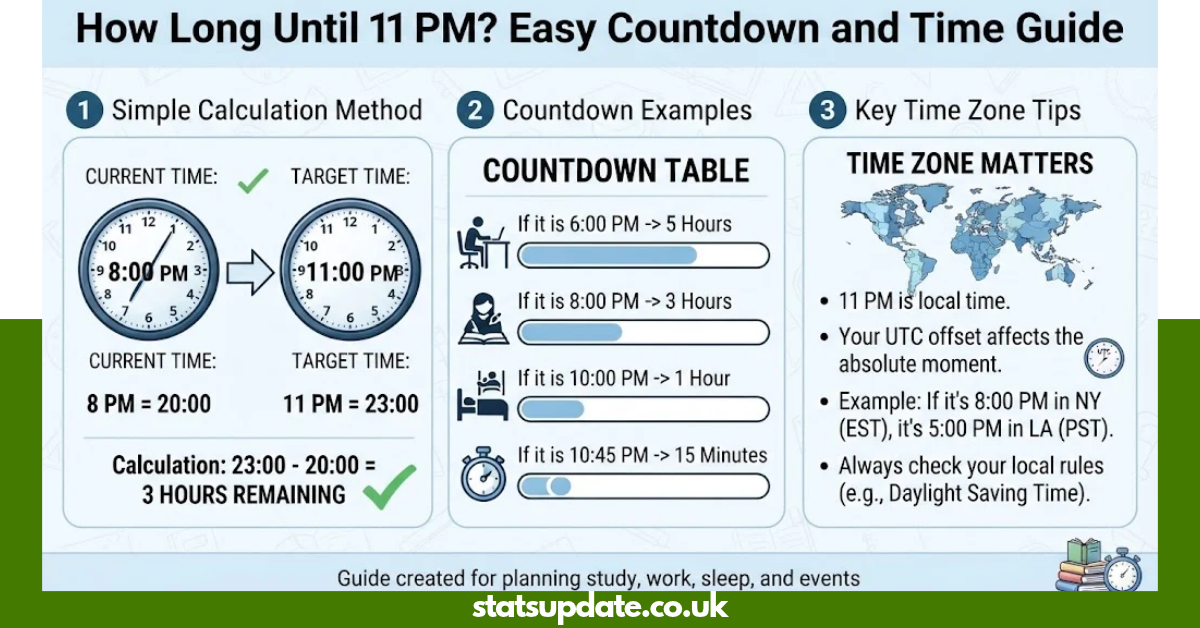
The answer depends on your current local time. If your clock shows 8:00 PM, you have 3 hours until 11 PM. If it is 10:30 PM, only 30 minutes remain.
For a simple calculation, compare your current local time with 11:00 PM, which is 23:00 in the 24-hour clock. If 11 PM has already passed, the next target is usually 11 PM tomorrow. Your local time zone matters because civil time is based on local clock rules and UTC offsets.
What Does “How Long Until 11 PM” Mean?
The question asks for the amount of time between the present moment and the next 11:00 PM.
The target can be:
- 11:00 PM today if it has not arrived yet.
- 11:00 PM tomorrow if today’s 11 PM has already passed.
- A different absolute moment when comparing people in different time zones.
In 24-hour notation, 11 PM is written as 23:00. This makes time subtraction easier and reduces confusion between AM and PM.
How Do You Calculate How Long Until 11 PM?
The easiest method is to subtract your current time from 23:00.
Simple formula
Time remaining = 23:00 − current local time
For example, if the current time is 7:30 PM:
23:00 − 19:30 = 3 hours 30 minutes
So, you have 3 hours and 30 minutes remaining.
If your current time is in the morning, you can still use the same 24-hour method. For example:
23:00 − 09:00 = 14 hours
This method works for hours and minutes without needing a special calculator.
How Long Until 11 PM From Common Times?
The following table gives quick examples for common evening times.
| Current Time | Time Until 11 PM |
| 5:00 PM | 6 hours |
| 6:00 PM | 5 hours |
| 7:00 PM | 4 hours |
| 7:30 PM | 3 hours 30 minutes |
| 8:00 PM | 3 hours |
| 8:30 PM | 2 hours 30 minutes |
| 9:00 PM | 2 hours |
| 9:15 PM | 1 hour 45 minutes |
| 9:30 PM | 1 hour 30 minutes |
| 10:00 PM | 1 hour |
| 10:15 PM | 45 minutes |
| 10:30 PM | 30 minutes |
| 10:45 PM | 15 minutes |
| 10:59 PM | 1 minute |
| 11:00 PM | 0 minutes |
The table gives a fixed example rather than a live countdown. The actual answer changes as the clock moves forward.
How Long Until 11 PM If It Is Already Past 11 PM?
If it is already after 11 PM, today’s target has passed.
For example, if the current time is 11:30 PM, you are not 30 minutes away from 11 PM. Instead, the next 11 PM is tomorrow, which is 23 hours and 30 minutes away.
This is important when setting reminders, alarms, bedtime schedules, or deadlines.
| Current Time | Next 11 PM |
| 11:01 PM | 23 hours 59 minutes |
| 11:15 PM | 23 hours 45 minutes |
| 11:30 PM | 23 hours 30 minutes |
| 11:45 PM | 23 hours 15 minutes |
| 11:59 PM | 23 hours 1 minute |
| 12:00 AM | 23 hours |
A countdown should therefore identify the next occurrence of 11 PM instead of assuming that today’s target is still available.
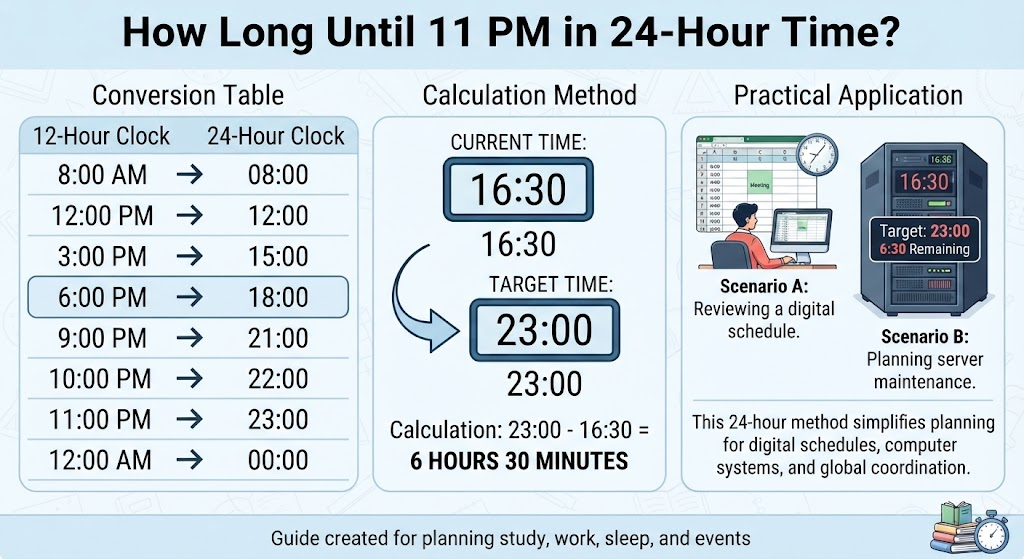
How Long Until 11 PM in 24-Hour Time?
Understanding the 24-hour clock makes the calculation much easier.
| 12-Hour Clock | 24-Hour Clock |
| 8:00 AM | 08:00 |
| 12:00 PM | 12:00 |
| 3:00 PM | 15:00 |
| 6:00 PM | 18:00 |
| 9:00 PM | 21:00 |
| 10:00 PM | 22:00 |
| 11:00 PM | 23:00 |
| 12:00 AM | 00:00 |
The biggest point to remember is that 11 PM = 23:00.
For example, if the current time is 16:30, subtract it from 23:00:
23:00 − 16:30 = 6 hours 30 minutes
This approach is especially useful when working with digital schedules and computer systems.
How Long Until 11 PM in Minutes?
Sometimes you may want the remaining time entirely in minutes.
One hour contains 60 minutes, so you can convert the remaining hours into minutes.
For example, if it is 8:30 PM:
- 8:30 PM to 9:00 PM = 30 minutes
- 9:00 PM to 11:00 PM = 120 minutes
- Total = 150 minutes
Therefore, 2 hours and 30 minutes equals 150 minutes.
Quick conversion table
| Time Remaining | Minutes |
| 15 minutes | 15 |
| 30 minutes | 30 |
| 45 minutes | 45 |
| 1 hour | 60 |
| 1 hour 30 minutes | 90 |
| 2 hours | 120 |
| 2 hours 30 minutes | 150 |
| 3 hours | 180 |
| 4 hours | 240 |
| 5 hours | 300 |
How Long Until 11 PM in Seconds?
A countdown can also display the remaining time in seconds.
There are 60 seconds in one minute. So, if 30 minutes remain:
30 × 60 = 1,800 seconds
If 2 hours remain:
2 × 60 × 60 = 7,200 seconds
A live countdown usually converts the remaining interval into hours, minutes, and seconds so it is easier to understand.
Why Does the Answer Change Every Second?
A time countdown is dynamic because the current time keeps moving.
Imagine the clock is exactly 9:00 PM. At that moment, two hours remain. One minute later, the remaining time is 1 hour and 59 minutes.
This means a fixed statement such as “two hours left” is only accurate at the moment it is calculated. A live countdown continuously updates the difference between the current moment and the target.
Does Your Time Zone Affect the Countdown?
Yes. Local time zones can change the answer when people are in different locations.
UTC is an international reference time scale, while local clocks use time-zone offsets and, in some places, daylight-saving rules. NIST explains that local time can be expressed as an offset from UTC, while IANA maintains time-zone data that records local clock rules and changes.
For example, two people can both see 9:00 PM on their local clocks while living in different parts of the world. Their local 11 PM occurs at different moments relative to UTC.
Why this matters
Time zones are important when you are:
- Joining an online meeting
- Watching a live event
- Setting an international deadline
- Calling someone abroad
- Scheduling a flight
- Coordinating work across countries
A good countdown should use the viewer’s intended local time.
What Happens When Daylight Saving Time Changes?
Daylight saving time can make time calculations more complicated in regions that use it.
NIST notes that UTC itself is not adjusted for daylight saving time, while local clocks in regions that observe DST can change.
IANA’s time-zone database records local time and daylight-saving rules for many locations. These rules can change when governments update their legal time policies, so software needs current time-zone data for accurate local conversions.
For a normal same-day countdown to 11 PM, this usually does not create a problem. It becomes more important when calculating across a clock-change date or comparing different regions.
How Long Until 11 PM for Daily Planning?
An 11 PM countdown can help divide the remaining evening into smaller tasks.
Instead of looking at the whole evening as one large block, you can create short periods for work, study, meals, relaxation, or preparation for sleep.
Example evening plan
| Time | Activity |
| 7:00–8:00 PM | Dinner and break |
| 8:00–9:00 PM | Study or focused work |
| 9:00–9:30 PM | Short break |
| 9:30–10:30 PM | Finish important tasks |
| 10:30–10:50 PM | Prepare for tomorrow |
| 10:50–11:00 PM | Wind down |
The exact schedule should match your routine. The useful idea is to turn the remaining time into clear blocks rather than repeatedly checking the clock.
How Long Until 11 PM for Study and Work?
Students and workers often use an evening cutoff to organize unfinished tasks.
If you have two hours until 11 PM, you could split that period into two focused 50-minute sessions with a short break. If only 30 minutes remain, choose one small task instead of starting a large project.
A simple planning rule
Longer time: complete larger tasks.
Medium time: finish one priority.
Short time: review, organize, or prepare.
This makes the countdown more useful than simply watching the minutes disappear.
How Long Until 11 PM for Sleep?
If 11 PM is your planned bedtime, knowing the remaining time can help you create a simple wind-down routine.
For example, if it is 10 PM, you have one hour. You could use part of that time to finish essential tasks, prepare clothes for the next day, reduce distractions, and get ready for bed.
The countdown itself does not determine how much sleep you need. It simply tells you how much time remains before your chosen 11 PM target.
How Long Until 11 PM for Events and Deadlines?
An 11 PM deadline can be easier to manage when you convert the remaining time into smaller milestones.
For example, if an assignment is due at 11 PM and it is currently 8 PM, you have three hours. You could spend the first hour creating the main work, the second hour completing details, and the final hour checking everything before submission.
For an online event, always check whether 11 PM means your local time or another location’s time. International schedules should clearly state a time zone to prevent confusion.
How Do Online Countdown Timers Work?
A basic countdown compares the current time with a target timestamp.
The general process is:
- Read the current date and time.
- Identify the user’s time zone.
- Set the target to 11 PM.
- Check whether today’s target has already passed.
- If necessary, move the target to the following day.
- Calculate the difference.
- Display the remaining hours, minutes, and seconds.
- Update the result as time passes.
Modern software can use time-zone databases to convert timestamps correctly for different locations. IANA’s time-zone database is designed to represent local-time rules and UTC offsets used by software systems.
Common Mistakes When Calculating the Time
A few simple mistakes can produce the wrong answer.
Confusing AM and PM
11 AM and 11 PM are twelve hours apart. Always confirm that the target is 11 PM.
Forgetting midnight
If today’s 11 PM has passed, the next target is tomorrow’s 11 PM.
Ignoring minutes
If it is 9:40 PM, the answer is not simply two hours. It is 1 hour and 20 minutes.
Using another person’s time zone
A countdown should normally be based on the location whose time you actually need.
Relying on an outdated device clock
If your phone or computer has the wrong date, time, or time-zone setting, a countdown can also show the wrong result.
Quick Reference: Time Until 11 PM
Here is a compact reference you can use without doing the math each time.
| Current Time | Remaining Time |
| 4:00 PM | 7 hours |
| 5:00 PM | 6 hours |
| 6:00 PM | 5 hours |
| 7:00 PM | 4 hours |
| 8:00 PM | 3 hours |
| 9:00 PM | 2 hours |
| 10:00 PM | 1 hour |
| 10:30 PM | 30 minutes |
| 10:45 PM | 15 minutes |
| 10:55 PM | 5 minutes |
| 10:59 PM | 1 minute |
| 11:00 PM | 0 minutes |
| 11:30 PM | 23 hours 30 minutes until the next 11 PM |
Why UTC Matters for Accurate Timekeeping
For ordinary daily use, you usually only need your local clock. Behind many digital time systems, however, international reference scales help synchronize clocks and timestamps.
The Bureau International des Poids et Mesures (BIPM) explains that Coordinated Universal Time, or UTC, is the international reference time scale used for coordinated dissemination of time signals.
NIST also maintains real-time realizations of UTC and explains how local time relates to UTC through time-zone offsets.
These standards matter when computers, telecommunications systems, scientific instruments, financial systems, and international services need to agree about the same moment.
How Long Until 11 PM: Fast Calculation Examples
Here are several practical examples.
Example 1: It is 6:20 PM
From 6:20 PM to 7:00 PM is 40 minutes.
From 7:00 PM to 11:00 PM is 4 hours.
Answer: 4 hours 40 minutes.
Example 2: It is 9:45 PM
From 9:45 PM to 10:00 PM is 15 minutes.
From 10:00 PM to 11:00 PM is one hour.
Answer: 1 hour 15 minutes.
Example 3: It is 10:50 PM
Only 10 minutes remain.
Answer: 10 minutes.
Example 4: It is 11:20 PM
Today’s target has passed.
The next 11 PM is tomorrow.
Answer: 23 hours 40 minutes.
These examples show why the date and exact local time matter when calculating the next target.
Frequently Asked Questions
There are 3 hours between 8 PM and 11 PM.
There are 2 hours between 9 PM and 11 PM.
There is 1 hour remaining.
11 PM is 23:00 in the 24-hour clock.
The countdown reaches zero. If you want the next occurrence, the following target is 11 PM tomorrow.
Yes. Local clocks use time-zone rules and UTC offsets, so the countdown should use the correct location and local time. Time-zone rules can also include daylight-saving changes.
Conclusion
The simplest way to calculate how long until 11 pm is to compare your current local time with 23:00. Before 11 PM, subtract the current time from 23:00. After 11 PM, calculate toward tomorrow’s 11 PM.
For everyday planning, a quick table or manual calculation is enough. For international schedules, digital events, and precise countdowns, make sure the correct local time zone and current clock settings are being used.