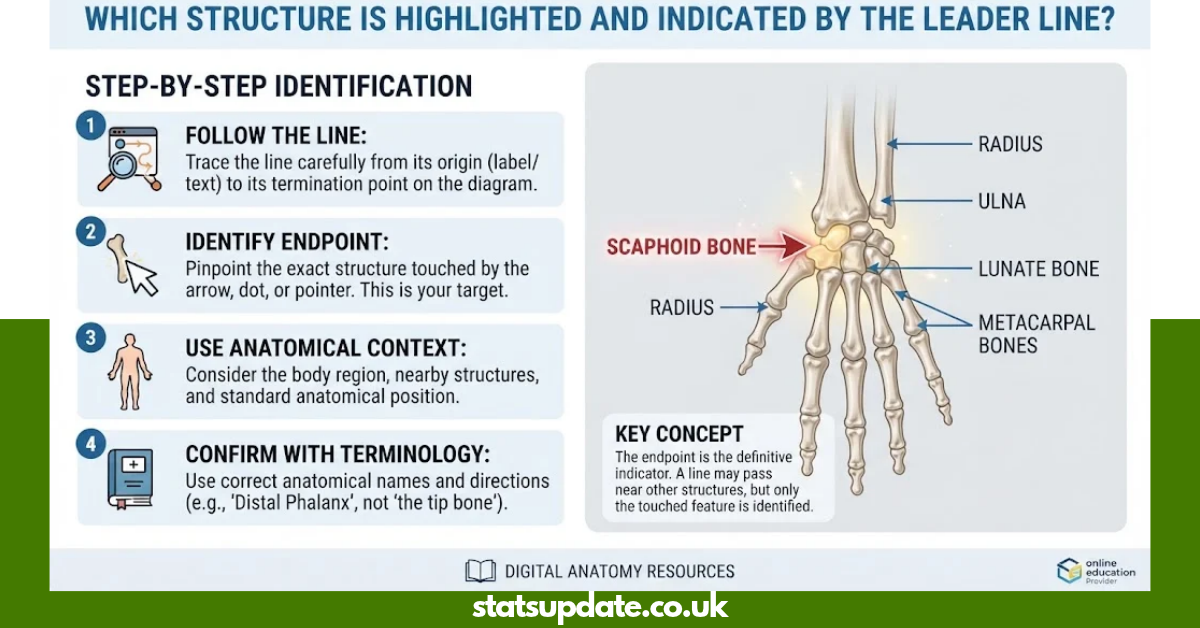
When a question asks, which structure is highlighted and indicated by the leader line?, follow the leader line carefully from its label or starting point to its exact endpoint. The structure touched by the arrow, dot, or pointer is the intended answer.
In anatomy diagrams, do not identify a structure simply because it looks highlighted or is located near the line. Check the exact endpoint and use anatomical position, direction, body region, and nearby landmarks to confirm the structure. Standard anatomical terminology helps distinguish structures accurately.
What Is a Leader Line?
A leader line is a thin line used to connect a label, number, or pointer with a particular feature in a diagram. In technical drawings, leader lines can end with an arrowhead or another termination mark that touches the feature being identified.
In anatomy and physiology diagrams, the same basic idea helps students identify organs, bones, muscles, vessels, tissues, and other structures. The line keeps the label away from the crowded image while still showing exactly what the label refers to.
Which Structure Is Highlighted and Indicated by the Leader Line?
The answer is the structure at the exact endpoint of the leader line.
This is important because the line may pass over or close to several structures before reaching its target. The nearby structures are not necessarily the answer. Trace the line all the way to its final point.
For example, if a line crosses a muscle and ends on a bone, the bone is the structure being identified. If it passes near a blood vessel but ends inside a chamber of the heart, the chamber is the target.
How Do You Follow a Leader Line Correctly?
Use this simple process:
- Find the starting point. Locate the label, number, or arrow connected to the line.
- Trace the line slowly. Follow its path without jumping to a nearby structure.
- Find the endpoint. Look for the arrowhead, dot, or exact point where the line finishes.
- Identify the structure underneath that endpoint.
- Check the anatomical position. Confirm that the structure fits its location.
- Compare nearby structures. Make sure you have not confused two structures that sit close together.
This approach works particularly well when a diagram contains several overlapping anatomical structures.
Why Is the Leader Line Important in Anatomy Questions?
Anatomy diagrams often contain many structures in a small space. A label placed directly over the structure could hide important details, so a leader line allows the label to remain outside the main illustration.
The leader line also makes the intended target more precise. Anatomical terminology provides another layer of accuracy because terms such as anterior, posterior, medial, lateral, superior, and inferior describe where one structure lies in relation to another.
Which Structure Is Highlighted and Indicated by the Leader Line in Anatomy?
There is no universal anatomical answer to this question without seeing the specific diagram.
A leader line could identify a structure from almost any body system. Depending on the image, the target could be a bone, muscle, organ, artery, vein, nerve, gland, tissue layer, brain region, or another anatomical feature.
For example, anatomy diagrams may use leader lines to identify:
| Body System or Area | Possible Structures |
| Skeletal system | Femur, skull, sternum, scapula |
| Muscular system | Biceps brachii, deltoid, gastrocnemius |
| Cardiovascular system | Aorta, vena cava, atrium, ventricle |
| Nervous system | Cerebrum, thalamus, cerebellum |
| Integumentary system | Epidermis, dermis, sweat gland |
| Respiratory system | Trachea, bronchi, lungs |
| Digestive system | Stomach, liver, pancreas |
| Urinary system | Kidney, ureter, urinary bladder |
| Reproductive system | Ovary, uterus, prostate |
| Endocrine system | Thyroid, pituitary, adrenal gland |
The exact image therefore matters more than the wording of the question alone.
How Can You Identify the Structure Without Guessing?
Start by determining the body region shown in the diagram.
For example, a diagram showing the skull narrows the possible answers to structures associated with the head. A diagram showing the heart points you toward cardiovascular anatomy. Once the region is clear, use the leader line endpoint to narrow the answer further.
Standard anatomical terms can then help confirm the location. For example, medial means toward the body’s middle, while lateral means toward the side. Superior describes a position above another structure, while inferior describes a position below it.
Use Anatomical Position to Confirm the Answer
Anatomical position provides a standard reference for describing the human body. In this position, the body stands upright, faces forward, and has the palms facing forward.
This standard makes diagrams easier to interpret because the same directional terms retain their meaning even when the body is shown from a different view.
Useful terms include:
| Term | Simple Meaning |
| Anterior | Toward the front |
| Posterior | Toward the back |
| Superior | Above |
| Inferior | Below |
| Medial | Toward the middle |
| Lateral | Toward the side |
| Proximal | Closer to the trunk or attachment point |
| Distal | Farther from the trunk or attachment point |
| Superficial | Closer to the surface |
| Deep | Farther from the surface |
These terms can help you confirm whether the structure indicated by the leader line matches its expected position.
What If the Leader Line Crosses Another Structure?
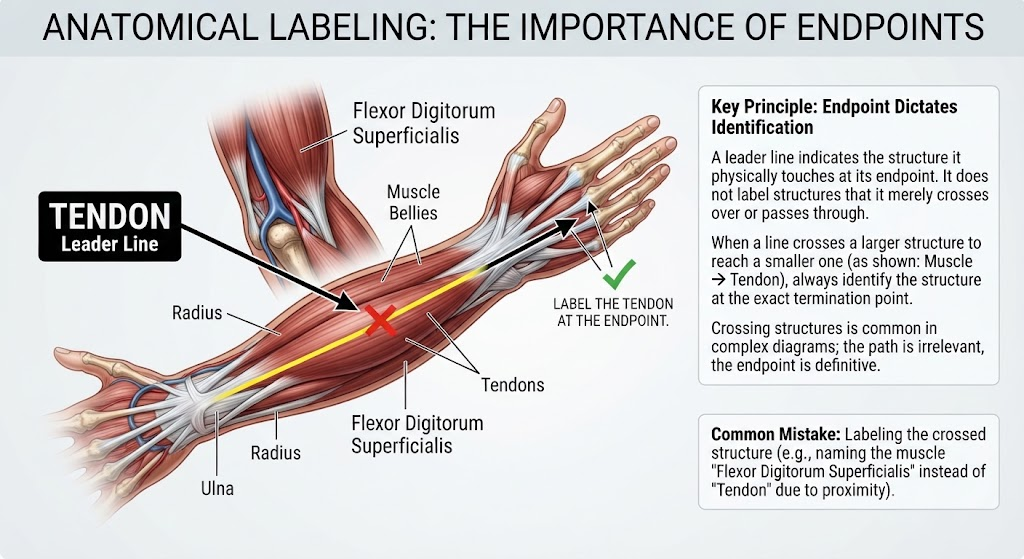
Do not automatically choose the structure that the line crosses.
A leader line can travel across one or more structures before reaching its target. The endpoint carries more importance than the path of the line.
For example, imagine a line traveling across a large muscle and ending on a small tendon. The muscle may appear more noticeable, but the tendon is the intended answer if the line terminates there.
This is one of the most common mistakes students make when answering diagram-based questions.
What If Several Leader Lines Are Close Together?
Zoom in and inspect the endpoints individually.
When several lines point toward nearby structures, follow each line separately. Do not assume that two lines pointing into the same general region identify the same structure.
Technical drawing standards also emphasize clear leader-line placement and appropriate termination so the intended feature can be identified accurately.
A Useful Checking Method
Ask yourself three questions:
- Where does the line start?
- Where exactly does it end?
- What structure is touching that endpoint?
If you can answer all three, you can usually identify the correct structure without guessing.
How Do Anatomical Views Affect the Answer?
The same structure can look different depending on the viewing direction.
Common anatomical views include:
- Anterior view: Looking at the front.
- Posterior view: Looking at the back.
- Lateral view: Looking from the side.
- Superior view: Looking from above.
- Inferior view: Looking from below.
The viewing angle matters because the apparent position of a structure can change. Anatomical diagrams also use sagittal, frontal, and transverse planes to show different sections of the body.
Understanding the view prevents mistakes when two structures look similar from one angle.
Which Structure Is Highlighted and Indicated by the Leader Line in a Brain Diagram?
Brain questions require extra attention because many structures are located close together.
A leader line might point toward the cerebrum, cerebellum, thalamus, brainstem, corpus callosum, or another region. The exact endpoint must be checked before selecting an answer.
Brain diagrams can also use sagittal, coronal, and horizontal sections. Knowing the section or viewing plane makes it easier to determine the location of the indicated structure.
Which Structure Is Highlighted and Indicated by the Leader Line in a Heart Diagram?
Heart diagrams commonly contain several structures packed into a small area. A leader line may identify a chamber, valve, vessel, septum, or another feature.
Look at the endpoint rather than the size or color of the highlighted area. Then use the structure’s position relative to the atria, ventricles, aorta, pulmonary vessels, and other landmarks to confirm the answer.
For example, a line ending inside a chamber should not be confused with one ending on the wall separating chambers.
Which Structure Is Highlighted and Indicated by the Leader Line in a Skin Diagram?
Skin diagrams can be especially tricky because several layers and structures appear together.
Possible targets include:
- Epidermis
- Dermis
- Hypodermis
- Hair follicle
- Sebaceous gland
- Sweat gland
- Arrector pili muscle
- Blood vessels
- Sensory receptors
Look at the depth of the leader-line endpoint. The epidermis is the outer layer, while the dermis lies underneath it and the hypodermis is deeper. Correctly identifying the layer depends on the exact location shown in the diagram.
Common Mistakes When Answering Leader-Line Questions
Avoid these mistakes:
Choosing the Closest Structure
The closest structure to the line is not always the target. The endpoint determines the intended structure.
Following the Highlight Instead of the Line
Color can attract attention, but the leader line provides the specific identification point.
Ignoring the Viewing Direction
A posterior view and an anterior view can make the same anatomical area look very different.
Guessing From the Question Alone
The wording which structure is highlighted and indicated by the leader line? does not identify a universal structure. The diagram is essential.
Stopping Before the Endpoint
A line can cross several structures before reaching the correct one. Always follow it to the end.
Quick Comparison: Leader Line vs Highlighted Area
| Feature | Leader Line | Highlighted Area |
| Main purpose | Points to a specific structure | Makes an area visually noticeable |
| Best clue | Exact endpoint | Shape, color, or shading |
| Can cross other structures? | Yes | Not applicable |
| Can identify a small structure? | Yes | Sometimes difficult |
| Should you rely on it alone? | Check endpoint and anatomy | Confirm with the diagram |
| Common exam use | Precise identification | Visual emphasis |
The leader line is especially useful when several structures overlap or sit very close together.
A Simple Exam Strategy
When you see the question which structure is highlighted and indicated by the leader line?, use this five-step method:
Step 1: Identify the body system.
Step 2: Identify the anatomical view.
Step 3: Trace the leader line.
Step 4: Locate the exact endpoint.
Step 5: Match that point with the correct anatomical name.
Then read the answer choices carefully. If two choices appear similar, use their anatomical location and relationship to neighboring structures to separate them.
Frequently Asked Questions
The indicated structure is the one located at the exact endpoint of the leader line. You need the specific diagram to determine its anatomical name.
A leader line connects a label, number, or pointer to a specific anatomical feature. Its endpoint shows which structure the label refers to.
Follow the leader line to its endpoint first. Use the highlighted color as supporting information rather than assuming it is the answer.
Ignore the structures it crosses and continue following the line. The structure at the final endpoint is normally the intended target.
Leader lines keep labels away from crowded illustrations while still connecting each label to the correct structure. This improves clarity and reduces confusion.
Usually not with certainty. The same question wording can be used for many different anatomy diagrams, so the image or answer choices are needed to identify the exact structure.
Conclusion:
The safest way to answer which structure is highlighted and indicated by the leader line? is simple: trace the line to its exact endpoint, identify the structure touching that endpoint, and then confirm its position using anatomical terminology.
Do not choose an answer based only on color, size, or the structure that appears closest to the line. If this is an anatomy quiz question, the actual image is the deciding evidence. Standard anatomical terms and viewing planes can then help you verify the answer with confidence.