A software implementation can look promising during planning but become difficult when real employees start using the system. Delays, unexpected costs, missing features, and poor communication can turn a useful technology project into a frustrating experience. Understanding why immorpos35.3 software implementations fail requires examining the entire implementation process, from initial requirements and system configuration to employee training, integration, and ongoing support. By identifying these risks early, businesses can make better decisions, reduce avoidable mistakes, and create a more reliable path to successful software adoption.
What Does Immorpos35.3 Software Implementation Mean?
Software implementation is the process of preparing a system for actual use in a business. It may include installation, configuration, data migration, connecting other applications, testing, employee training, and ongoing maintenance.
However, there is an important point about Immorpos35.3: publicly available descriptions do not establish a consistent, independently verified product identity. Before applying any product-specific troubleshooting advice, confirm the developer, exact version, supported features, and official documentation.
A practical implementation should answer five questions:
- What business problem must the software solve?
- Which features does the exact version support?
- What information must the team import?
- Which existing systems must connect to it?
- How will the business measure success?
Without clear answers, even a well-designed software product can fail to meet expectations.
Why Immorpos35.3 Software Implementations Fail
The phrase why immorpos35.3 software implementations fail points to several common software project risks. These include weak planning, unclear requirements, poor data quality, integration problems, insufficient testing, and limited employee support.
The following table summarizes the main risks and practical ways to address them. These are general software implementation risks, not verified defects in Immorpos35.3.
Complete Software Implementation Failure Analysis
| Failure point | What can go wrong | Business impact | Recommended solution |
| Poor planning | The team starts without clear goals | Delays and extra costs | Create a detailed project plan |
| Unclear requirements | Essential workflows remain undocumented | Missing features or workarounds | Document requirements before configuration |
| Unverified product identity | The supplier or software version cannot be confirmed | Security and purchasing risks | Verify the developer and official documentation |
| Data migration errors | Records are missing, duplicated, or incorrectly mapped | Unreliable business reports | Clean and validate data before importing |
| Integration failures | Connected applications exchange incorrect or incomplete data | Disrupted workflows | Test every required connection |
| Inadequate testing | Important problems remain undiscovered | Production errors | Test realistic business scenarios |
| Limited employee training | Staff do not know how to complete tasks | Low adoption and more support requests | Provide role-specific training |
| Excessive customization | Changes increase complexity | Higher costs and maintenance effort | Use standard features where practical |
| Weak communication | Departments disagree about priorities | Rework and delayed decisions | Assign clear responsibilities |
| Unrealistic deadlines | Testing and training get shortened | Unstable launch | Set milestones based on actual workload |
| Security gaps | Access permissions or safeguards are inadequate | Data exposure and operational risk | Review access, backups, and security controls |
| Poor post-launch support | Issues remain unresolved | Falling confidence and productivity | Assign an owner and monitor performance |
This checklist provides a starting point for investigating why immorpos35.3 software implementations fail without assuming that every problem applies to the named product.
Poor Planning and Unrealistic Project Goals
Poor planning is one of the most common causes of software implementation trouble. A business may set a launch date before understanding its processes, technical requirements, staffing needs, or data migration workload.
When the schedule becomes tight, teams may skip important tasks to meet the deadline. This often moves problems from the planning stage into the live environment, where fixing them costs more time and money.
How to prevent it:
- Define the business goals before selecting implementation dates.
- Assign a project manager and department representatives.
- Break the work into smaller, measurable milestones.
- Include time for testing, training, and unexpected problems.
- Review progress weekly and document major decisions.
A realistic schedule gives the team enough time to solve problems before they affect customers.
Unclear Software Requirements
Another reason why immorpos35.3 software implementations fail may be that a business never clearly defines what it needs from the system. Managers may focus on a list of features while overlooking the everyday tasks employees must perform.
For example, a retailer might need accurate stock updates, reliable sales reports, and a clear process for handling returned products. If these requirements remain undocumented, the implementation team may configure the system incorrectly or overlook essential workflows.
How to define requirements correctly
Start by speaking with the people who perform each task. Record their normal steps, common exceptions, approval requirements, and expected results.
Then classify each requirement as essential, desirable, or unnecessary. Ask the supplier to demonstrate essential functions in the exact version being considered.
This approach reduces misunderstandings and helps the business avoid expensive changes later.
Data Migration and Data Quality Problems
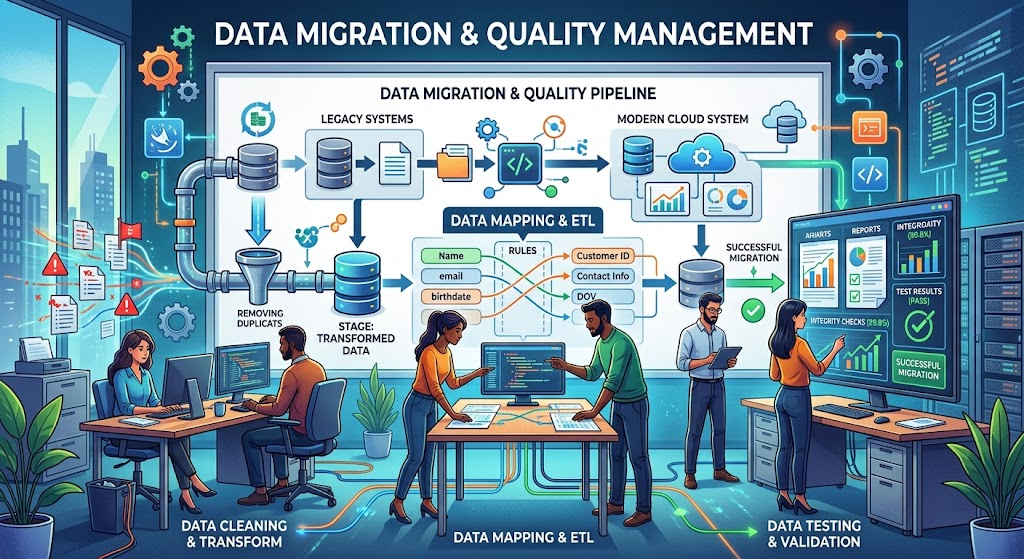
Data migration means moving information from an old application, spreadsheet, or database into a new system. The process can fail when records contain errors, use inconsistent formats, or do not match the new system’s data structure.
Imagine importing a customer list containing duplicate accounts, missing phone numbers, and inconsistent product codes. Even if the import completes successfully, employees may struggle to find the correct records, and reports may become inaccurate.
Practical data migration checklist
- Back up the original data before making changes.
- Remove duplicate records where appropriate.
- Standardize dates, currencies, names, and identifiers.
- Map old fields to the correct destination fields.
- Test a small sample before migrating everything.
- Compare record counts and totals after import.
- Obtain business approval before retiring the old system.
Data migration should be treated as a controlled business process, not simply a technical upload.
Integration and Compatibility Issues
Modern businesses often depend on several applications. A new system may need to exchange information with accounting software, customer relationship management tools, inventory databases, payment services, or reporting platforms.
Problems arise when the systems use incompatible data formats, different authentication methods, unsupported interfaces, or conflicting business rules. A connection that works during a short demonstration may also fail under normal workloads.
Before assuming that Immorpos35.3 supports a particular integration, request official technical documentation from the supplier.
Recommended checks include:
- Confirm that both systems support the proposed connection.
- Verify authentication, permissions, and data formats.
- Test successful transactions and failed transactions.
- Check how the integration handles duplicate or delayed records.
- Monitor logs and confirm that data reaches its destination.
- Test again after configuration changes or software updates.
Reliable integration requires evidence that the complete workflow works, not just proof that two applications can connect.
Insufficient Testing Before Launch
Testing helps identify errors before employees and customers depend on a new system. When teams test only basic functions, they may overlook unusual situations, heavy workloads, permission problems, and recovery procedures.
For example, a sales workflow may work correctly when one employee processes a transaction. It could behave differently when several employees work simultaneously or when the network connection drops.
Essential software testing stages
| Test type | Main purpose | Example |
| Functional testing | Checks individual features | Verify that a report calculates totals correctly |
| Integration testing | Checks communication between systems | Confirm that a completed transaction reaches accounting |
| Performance testing | Checks speed and stability | Simulate a busy operating period |
| Security testing | Checks access and protection | Confirm that restricted users cannot access sensitive records |
| User acceptance testing | Confirms that business needs are met | Ask employees to complete normal daily tasks |
| Recovery testing | Checks recovery from failures | Restore a backup in a controlled environment |
Teams should record each test, its expected result, the actual result, and any unresolved defect. Critical problems should be fixed and retested before launch.
Inadequate Employee Training
Employees may resist a new system when they do not understand how it changes their work. Even a suitable application can create confusion if staff receive only a brief demonstration or a long manual filled with technical terms.
Training should focus on real tasks rather than showing every menu and setting. Employees need to know how to perform their responsibilities, recognize common errors, and obtain help when something goes wrong.
How to improve user adoption
- Train employees according to their job roles.
- Use short demonstrations and practical exercises.
- Provide simple instructions for common tasks.
- Identify experienced employees who can support colleagues.
- Collect feedback during pilot testing.
- Offer additional help during the first weeks after launch.
Successful adoption depends on giving people enough practice and support to work confidently.
Excessive Customization and Configuration Errors
Businesses sometimes try to make new software match every detail of an existing workflow. Although customization can solve genuine business needs, unnecessary changes can increase complexity, testing requirements, and long-term maintenance costs.
Configuration errors can create similar problems. Incorrect permissions, tax settings, approval rules, or reporting options may produce results that appear normal but do not match business requirements.
The better approach is to understand the standard features first. Customize only when a documented business requirement cannot be met through supported configuration.
Before changing important settings, maintain a record of the original values, test changes in a separate environment, and prepare a rollback plan.
Weak Communication Between Teams
Software projects involve different people, including managers, IT specialists, employees, suppliers, and external consultants. When these groups do not share information, important decisions can be delayed or misunderstood.
For example, the finance team may expect a particular report, while the technical team believes a different report meets the requirement. The disagreement may remain hidden until the system reaches the testing stage.
Ways to improve project communication
- Hold short, regular project meetings.
- Maintain a shared list of requirements and decisions.
- Assign one person to approve important changes.
- Record unresolved problems and their deadlines.
- Give employees a clear way to report issues.
- Share progress updates with everyone affected.
Clear communication helps teams identify problems early and reduces unnecessary rework.
Budget Problems and Scope Creep
Software implementation costs can grow when businesses underestimate the work involved. Expenses may include licenses, consulting, training, infrastructure, data cleanup, integration, maintenance, and additional development.
Scope creep occurs when new requirements enter the project without reviewing their impact on cost, time, or resources. A small request may appear harmless, but several unplanned changes can delay the entire implementation.
How to control implementation costs
- Prepare a budget covering the full project lifecycle.
- Separate essential requirements from optional improvements.
- Record the cost and schedule impact of every major change.
- Obtain approval before starting additional work.
- Reserve funds for unexpected but necessary tasks.
- Compare actual spending against the approved budget.
A clear budget makes it easier to distinguish necessary investment from avoidable expense.
Security, Permissions, and Backup Failures
Security problems can undermine a software project even when its main features work correctly. Incorrect permissions may expose confidential information, while weak backup procedures can leave a business unable to recover from accidental deletion or system failure.
The National Institute of Standards and Technology (NIST) explains why access-control policies need systematic verification and testing. Its guidance highlights the importance of checking whether implemented permissions match the intended security rules.
CSRC
+1
Security checks before going live
- Give each employee only the access needed for their role.
- Require strong authentication where supported.
- Remove access for former employees promptly.
- Encrypt sensitive data where appropriate.
- Schedule regular backups.
- Test data restoration instead of assuming backups work.
- Review security logs and investigate unusual activity.
Do not upload confidential business records into an unfamiliar application until you have verified its source, security practices, and data-handling arrangements.
Poor Monitoring and Post-Launch Support
Launching the software does not mean the implementation is complete. New problems may appear when the system handles real transactions, larger workloads, or unusual user activity.
Without monitoring, a small issue can continue until it affects several departments. Employees may create manual workarounds, and managers may lose confidence in the new system.
Google Cloud’s Well-Architected Framework recommends operational monitoring, incident management, performance testing, and continuous improvement as part of reliable software operations.
Google Cloud Documentation
+1
Build a practical support process
- Assign a named person to manage post-launch issues.
- Define how employees report problems.
- Prioritize incidents by business impact.
- Monitor errors, performance, and failed transactions.
- Review recurring problems to find their root causes.
- Document fixes and update training materials.
- Schedule regular reviews after deployment.
A structured support process allows the team to improve the system instead of repeatedly fixing the same symptoms.
No Rollback or Business Continuity Plan
A rollout can fail because a business has no safe way to return to its previous working arrangement. If critical transactions stop processing, the absence of a recovery plan can extend disruption and increase financial losses.
A rollback plan explains when the team should stop a deployment, who makes that decision, how the previous environment will be restored, and how data created during the transition will be handled.
Before launch, establish clear rollback conditions. Test the backup and restoration process, prepare a communication plan, and decide how essential operations will continue if the new system becomes unavailable.
Google Cloud’s guidance on recovery testing also recommends testing failover, rollback, and data restoration rather than relying on written procedures alone.
How to Implement Immorpos35.3 Software More Successfully
The following step-by-step plan can help businesses manage implementation risks while confirming the capabilities of the exact software they intend to use.
Step 1: Verify the software
Confirm the developer, version number, licensing terms, official documentation, supported features, and vendor contact details.
Step 2: Document business needs
List required workflows, user roles, reports, integrations, security controls, and measurable outcomes.
Step 3: Prepare and migrate data
Clean the existing records, create backups, map fields, and validate a sample migration before transferring the full dataset.
Step 4: Test in a safe environment
Test core functions, integrations, permissions, performance, error handling, and recovery procedures before production use.
Step 5: Train users and launch gradually
Give employees practical training, run a pilot where possible, and resolve critical problems before expanding access.
Step 6: Monitor and improve
Track errors, completion times, user feedback, costs, and business outcomes. Assign responsibility for resolving recurring issues.
How to Measure Software Implementation Success
A project should not be judged only by whether the software installs or launches. The business must also determine whether the new system improves the work it was intended to support.
Define the baseline before implementation and compare the results after launch.
| Performance indicator | What it measures | How to evaluate it |
| Implementation schedule | Whether milestones are completed on time | Compare planned and actual dates |
| Budget performance | Whether spending stays within approved limits | Compare actual costs with the budget |
| Data accuracy | Whether migrated records are correct | Check record counts and sample records |
| System availability | Whether the system is accessible when needed | Review uptime and incident records |
| Error rate | How often transactions or tasks fail | Compare errors over time |
| User adoption | Whether employees use the new system | Review usage and task completion |
| Support workload | How much help users require | Track support requests and recurring issues |
| Business outcomes | Whether the original goals are achieved | Compare relevant operational metrics |
The targets should reflect the organization’s needs rather than arbitrary industry averages. For example, a system handling critical transactions may need stricter availability targets than an internal tool used occasionally.
Common Mistakes to Avoid During Implementation
Businesses can reduce risk by avoiding these frequent mistakes:
- Skipping verification: Do not rely on an unfamiliar product name or unsupported marketing claims.
- Assuming compatibility: Confirm each integration and supported version.
- Migrating unclean data: Fix inconsistencies before importing records.
- Rushing employee training: Allow time for practice and feedback.
- Testing only normal cases: Include failures, unusual transactions, and recovery scenarios.
- Customizing everything: Prefer supported standard features when they meet business needs.
- Ignoring security: Check permissions, backups, and data handling before launch.
- Ending support too early: Continue monitoring after the initial rollout.
Microsoft’s implementation guidance offers additional detail on planning a test strategy, including security, usability, and data migration testing.
Expert Recommendations for Troubleshooting Implementation Failures
When an implementation starts to go wrong, avoid changing several settings at once without understanding the cause. Begin with the evidence, reproduce the issue safely, and determine whether it comes from configuration, data, integration, permissions, infrastructure, or user workflow.
Use this troubleshooting sequence:
- Describe the problem: Record the exact error, affected users, and business task.
- Check the evidence: Review logs, timestamps, recent changes, and relevant system documentation.
- Reproduce the issue: Test it in a controlled environment when possible.
- Identify the root cause: Separate the underlying problem from its visible symptoms.
- Apply a controlled fix: Make one documented change at a time.
- Retest the workflow: Confirm that the fix works and does not break another function.
- Record the outcome: Document the cause, resolution, and steps needed to prevent recurrence.
If the problem concerns Immorpos35.3 specifically, use the verified vendor’s support channel and exact version documentation. Do not apply unofficial commands, undocumented endpoints, or unverified patches to a production system.
Frequently Asked Questions
The main risks in software implementations are poor planning, unclear requirements, data migration errors, integration failures, inadequate testing, and insufficient training. These are general implementation risks; product-specific causes require reliable technical evidence.
Its identity is not established by the reliable product documentation identified for this article. Several websites describe it differently, so verify the developer, official website, version information, and licensing before installing it or sharing business data.
Start by verifying the software, documenting business requirements, preparing clean data, testing integrations, training employees, and creating a recovery plan. Test the complete workflow before allowing the system to handle live operations.
Yes. Missing records, duplicate entries, incorrect field mappings, and inconsistent formats can lead to inaccurate reports and interrupted workflows. A controlled migration with backups, sample imports, and post-import validation helps reduce these risks.
Training helps employees complete tasks correctly, understand new workflows, and recognize common errors. Role-specific exercises and continued support can improve adoption and reduce avoidable mistakes.
Protect existing data, identify the business impact, document the problem, and involve the verified supplier or qualified technical team. Restore a previous working environment if necessary and safe, then retest the corrected system before resuming normal operations.
Conclusion
Understanding why immorpos35.3 software implementations fail starts with separating verified product information from common software project risks. Weak planning, unclear requirements, data problems, integration failures, insufficient testing, and poor user support can all prevent a business from achieving its goals. However, careful preparation, realistic deadlines, structured testing, employee training, and ongoing monitoring can help reduce these risks.
Before committing to Immorpos35.3, confirm its identity and obtain documentation for the exact version. Then test essential workflows with representative data, define measurable success criteria, and prepare a recovery plan before launch.
Your next step: Review your current implementation against the checklist and prioritize the risks that could cause the greatest operational or financial harm. If you have experienced a specific error, document what happened and share it with the verified software provider so the underlying cause can be investigated.